
Chipko Movement – Gaura Devi, Chandi Prasad Bhatt, Sunderlal Bahuguna Complete Story
– Mohit Bangari
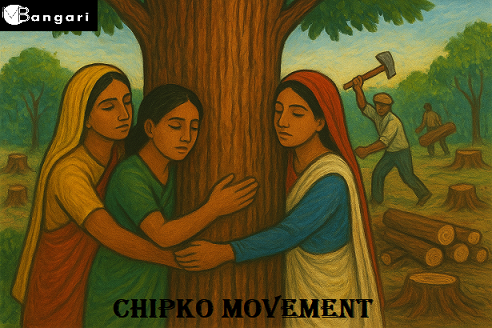
The Chipko Movement is one of India’s biggest environmental movements. It began in Uttarakhand Himalaya during the early 1970s. The word Chipko means “to hug.” Villagers hugged trees to save them from being cut by contractors.
Most people think that the Chipko Andolan started in Reni village under Gaura Devi, but the truth is different. The first Chipko protest actually happened in Mandal village in 1973, led by Chandi Prasad Bhatt and his team of Dasholi Gram Swarajya Mandal (DGSM). One year later, in 1974, the women of Reni, under the leadership of Gaura Devi, gave the movement a new strength and made it famous worldwide.
Table of Contents
Background of Chipko Movement
Forests in Uttarakhand have always been the backbone of village life. People depend on them for fuel, fodder, water, fruits, and medicines. But after independence, the government and contractors allowed large-scale tree cutting for commercial use.
This brought disasters like soil erosion, drying water sources, and landslides. The 1970 Alaknanda flood gave villagers a warning. They realised deforestation was harming their lives.
About the Leaders
Chandi Prasad Bhatt – Founder of DGSM, architect of the original Chipko
protest in Mandal (1973). Awarded Ramon Magsaysay Award in 1982.
Gaura Devi – Head of Mahila Mangal Dal of Reni, who led the women’s
Chipko in 1974. Symbol of courage and women’s power in environment.
Sunderlal Bahuguna – Gandhian environmentalist who spread
Chipko’s message, linked it to ecology, and influenced national policies.
Beginning of Chipko Movement – Mandal, 1973
The first action of Chipko started in April 1973 at Mandal village, Chamoli. At that time, the forest department gave 300 ash trees to a sports goods company. Villagers of DGSM, under Chandi Prasad Bhatt, opposed this order.
They hugged the trees, stopped contractors, and finally forced the government to cancel the permission. This was the original start of Chipko Andolan.
Gaura Devi and the Reni Incident, 1974
In 1974, another big event happened in Reni village, just 20 km away from Mandal. Contractors were again sent to cut trees. Men from the village were tricked away by officials. At that time, Gaura Devi, head of the Mahila Mangal Dal, stood up. She gathered 27 women and ran to the forest.
They formed a human chain around the trees and refused to move. When threatened, they said, “These forests are our mothers. We will not let you cut them.” Contractors had to return empty-handed.
This brave act of Gaura Devi and her group made the Chipko Movement a global symbol of women-led environmental struggle.
Role of Women in Chipko
Though the movement started with men of DGSM, it was the women who gave it life. Women directly depended on forests for daily needs. They carried water, collected firewood, and cut grass. That’s why they were more sensitive to forest destruction.
The courage of Gaura Devi showed the whole country how women can be protectors of the environment.
Spread of Chipko Movement
After Mandal and Reni, the movement spread to Tehri, Uttarkashi, Rudraprayag, and other districts. Leaders like Sunderlal Bahuguna joined and made it a people’s revolution. He walked across the Himalayas, spreading the message of forest conservation and sustainable living.
Chipko also inspired other struggles, like the Appiko Movement in Karnataka.
Achievements of Chipko
In 1980, PM Indira Gandhi banned cutting of green trees in Uttarakhand for 15 years.
Villagers gained a voice in forest management.
The world recognised Chipko as a Gandhian-style environmental protest.
Women got respect as leaders in environmental movements.
About Chandi Prasad Bhatt
Chandi Prasad Bhatt, born in 1934 in Gopeshwar, Chamoli, was the founder of DGSM (Dasholi Gram Swarajya Mandal). He is considered the real architect of the Chipko Movement. His aim was to connect villagers with forests in a sustainable way. In 1982, he was awarded the Ramon Magsaysay Award for his work.
Sunderlal Bahuguna and His Contribution
Sunderlal Bahuguna (1927–2021) was another key leader of the Chipko Andolan. A Gandhian by thought, he joined the movement in the mid-1970s. He did not start Chipko, but he gave it national recognition.
His main contributions were:
He undertook long padyatras (foot marches) of thousands of kilometres across Uttarakhand, spreading the message of Chipko.
He gave the movement a Gandhian character of non-violence, satyagraha, and moral force.
He connected Chipko with bigger environmental issues like sustainable development, ecology, and climate change.
He met the Prime Minister Indira Gandhi and convinced her to ban green tree felling in Uttarakhand for 15 years in 1980.
He also became famous later for his fight against the Tehri Dam project.
Because of his work, Chipko was not limited to Chamoli villages but became an all-India and international symbol of environmental activism.
About Gaura Devi
Gaura Devi was born in 1925 in Lata village near Nanda Devi National Park. She got married at the age of 12 to a man from Reni village. After her husband’s early death, she took care of her family and became active in village community work.
As the head of the Mahila Mangal Dal of Reni, she was always concerned about the environment and people’s problems. She believed that forests are not just trees, but a complete life-support system for mountain people.
Her leadership during the Reni incident made her the face of the Chipko Movement. She passed away in 1991, but her courage still inspires environmentalists across the world.
Importance of Chipko Today
The Chipko Movement reminds us that forests are not just for timber, they are life support for mountains. Landslides, climate change, and water shortage are still big problems. The message of Chandi Prasad Bhatt and Gaura Devi is clear – save forests, save life.
Results of the Chipko Movement
The Chipko Movement did not remain just a small village protest. It gave very strong results for Uttarakhand and also changed the way India looked at forests.
1. Ban on Green Tree Felling (1980):
The biggest achievement came in 1980, when Prime Minister Indira Gandhi announced a 15-year ban on cutting green trees in Uttarakhand Himalayas. This decision came after years of Chipko protests and after Sunderlal Bahuguna met her in Delhi.
2. Recognition of Villagers’ Rights:
Earlier, forests were treated only as government property. After Chipko, the importance of local people in forest protection was recognised. Villagers started to get a voice in deciding how forests should be used.
3. Women’s Empowerment:
The courage of Gaura Devi and the women of Reni showed that women are natural leaders in protecting the environment. It gave them respect in society and inspired other women movements in India.
4. Birth of Other Movements:
Chipko inspired the Appiko Movement in Karnataka (1983) and several other environmental struggles in different states. It became a model for peaceful and people-driven protest.
5. Global Awareness:
The Chipko story travelled across the world. It was seen as a Gandhian-style environmental movement, where poor villagers hugged trees instead of using violence. It influenced global discussions on sustainable development, ecology, and climate change.
6. Policy Changes in India:
The movement forced the government to rethink forest policies.
More focus came on social forestry, afforestation, and eco-development.
Forest protection became linked with people’s livelihood, not just timber business.
7. New Environmental Leadership:
The Chipko Movement gave India leaders like Chandi Prasad Bhatt, Sunderlal Bahuguna, and Gaura Devi, who later became symbols of eco-conscious leadership.
FAQs on Chipko Movement and Gaura Devi
Q1. Who started the Chipko Movement?
The Chipko Movement was started in 1973 at Mandal village, Chamoli by Chandi Prasad Bhatt and his group Dasholi Gram Swarajya Mandal (DGSM).
Q2. Was the Chipko Movement started by Gaura Devi?
No, Gaura Devi did not start the Chipko Movement. She became famous when she led the women of Reni village in 1974, where they hugged trees to stop contractors. Her action gave Chipko international attention.
Q3. What was the role of Sunderlal Bahuguna in Chipko Movement?
Sunderlal Bahuguna spread the message of Chipko through padyatras across Uttarakhand. He gave the movement a Gandhian form of non-violence, raised awareness about ecology, and convinced Indira Gandhi to ban green tree felling in 1980.
Q4. Why is the Chipko Movement important?
It saved thousands of trees, stopped commercial deforestation in Uttarakhand, and inspired other environmental movements like the Appiko Movement in Karnataka. It also highlighted the role of women in environmental protection.
Q5. Who were the main leaders of the Chipko Movement?
The main leaders were Chandi Prasad Bhatt, Gaura Devi, and Sunderlal Bahuguna. Each of them contributed in different ways – Bhatt started it, Gaura Devi gave it global identity, and Bahuguna spread it nationally.
Q6. When did the government ban tree felling in Uttarakhand?
In 1980, Prime Minister Indira Gandhi announced a 15-year ban on green tree cutting in Uttarakhand after being influenced by the Chipko Movement.
Q7. What is the meaning of Chipko?
Chipko means “to hug” in Hindi. Villagers hugged trees to protect them from being cut.
Conclusion
The truth of the Chipko Movement is that it was first started in 1973 in Mandal by Chandi Prasad Bhatt, and later strengthened by Gaura Devi and the women of Reni in 1974. Both were important – one gave the foundation, the other gave the soul.
Today, Chipko is not only history, it is a lesson for future generations. Protecting nature is not the job of government only, it is everyone’s duty.
– Mohit Banagari
Related Post




Mohit Bangari
Explore Himalaya With Me!!


Explore the beauty and cultures of the Himalayas, from Jammu and Kashmir to Arunachal Pradesh, Tibet and Nepal. My blog shares stories, pictures, and fun articles about this amazing region. Come along on a journey where each mountain has a tale and every valley hides a treasure. Join me as I discover the magic of the mountains together.
Welcome to my Himalayan Adventure!