
British Era in Uttarakhand – A Detailed Story of Power, Change, and Himalayan Life
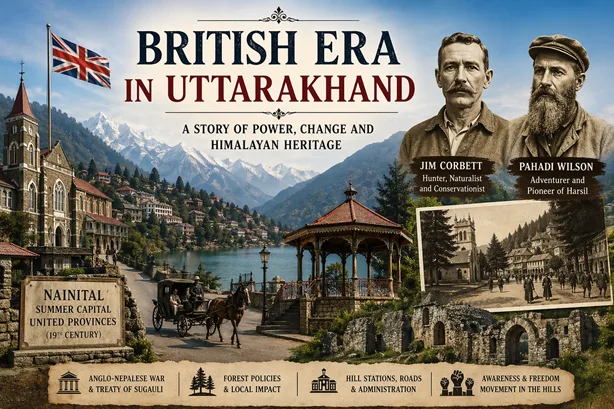
Table of Contents
Introduction – When the Hills Saw a Big Change
The British era in Uttarakhand is not just a simple historical phase. It is a long story of change that slowly reshaped the entire region. From administration to forests, from small villages to famous hill stations, everything saw a transformation during this time. Even today, when we visit places like Nainital or Mussoorie, we can clearly feel that colonial touch in buildings, roads, and town planning. However, behind this beauty, there is also a story of struggle, control, and adjustment. Local people had to adapt to new systems, new laws, and new ways of life. So, if we want to truly understand Uttarakhand, we must go deep into this period.
Before the British – A Land of Kingdoms and Traditions
Before the British entered Uttarakhand, the region was already rich in culture and traditions. It was mainly divided into two major parts, Kumaon and Garhwal, both ruled by their own dynasties. In Kumaon, the Chand rulers governed the land for many years, while in Garhwal, the Parmar (Panwar) kings held power. Life in those times was simple but organized. Villages were mostly self-dependent, and people depended on farming, cattle, and forests for their daily needs. Trade routes connected the hills with Tibet and the plains of India, which helped in cultural exchange as well. Religion and local traditions played a very strong role in everyday life. However, this peaceful system did not remain stable for long, as a new power soon entered the region.
The Gorkha Invasion – A Turning Point
In the late 18th century, the Gorkhas from Nepal began expanding their territory towards the west. They were strong and well-organized fighters. Slowly, they captured Kumaon in 1791 and then Garhwal in 1804. This period is remembered as a difficult time in Uttarakhand history. The Gorkha administration imposed heavy taxes on the people. Many villagers were forced to do labor, and strict rules controlled daily life. Because of this, dissatisfaction started growing among the local population. People wanted relief, but they did not have enough power to fight back. This situation later became one of the main reasons why the British found support when they entered the region.
Entry of the British – War in the Himalayas
The British did not come to Uttarakhand peacefully. Their entry happened through war. In the early 19th century, conflict increased between Nepal and the British East India Company, which finally led to the Anglo-Nepalese War. This war played a very important role in shaping the future of Uttarakhand. British forces attacked Gorkha-controlled areas and managed to capture Almora in 1815, which was a major centre in Kumaon. This victory weakened Gorkha control in the region. After continuous battles, the war ended with the Treaty of Sugauli, which officially transferred Kumaon and eastern Garhwal to British control. However, western Garhwal remained under a local king, forming the Tehri Garhwal princely state. This created a unique situation where two systems existed side by side.
A Region Divided – Two Systems, One Land
After the war, Uttarakhand was divided into two administrative parts. Kumaon and eastern Garhwal came under direct British rule, while Tehri Garhwal remained a princely state under its king, though under British supervision. This division had a long-term impact on the region’s development. In British areas, administration followed colonial policies, while in Tehri, traditional monarchy continued with some influence from the British. Even today, when we study the history of Uttarakhand, this difference is clearly visible in social and political development between these regions.
The Unique Administration of Kumaon
One of the most interesting aspects of British rule in Uttarakhand was its different administrative system. The British declared Kumaon a non-regulation province, which means strict laws of the plains were not applied here. Instead, officers were given flexibility to take decisions based on local conditions. This system worked well because the mountainous geography made communication and control difficult. The region was governed by commissioners, and among them, George William Traill played a very important role. He served for many years and understood the region deeply. Instead of forcing strict rules, he focused on maintaining balance in administration, revenue collection, and law and order. Because of this approach, his period is often seen as relatively stable compared to earlier times.
Land, Revenue, and the Changing Village System
During British rule, land management became more organised. Earlier, land ownership was mostly based on tradition, but the British wanted proper records and fixed taxation. They introduced land settlements where land was measured and ownership was recorded. Taxes were fixed based on productivity, which brought clarity to the system. However, this also created pressure on farmers, as they had to pay taxes even during bad agricultural seasons. Despite these challenges, many people felt that this system was still better than the unpredictable taxation during Gorkha rule. Slowly, village life started adapting to these new arrangements.
Birth of Hill Stations – A Colonial Dream in the Himalayas
One of the most visible impacts of British rule in Uttarakhand is the development of hill stations. The British were not comfortable with the hot climate of the plains, so they started developing towns in the cool Himalayan regions. Places like Nainital and Mussoorie became important centres. Nainital was developed as the summer capital of the United Provinces, where government offices shifted during summer months. Mussoorie became a popular retreat for British officers and their families. Similarly, Ranikhet was developed as a military cantonment, and Landour became a quiet colonial settlement. These towns were planned with proper roads, buildings, schools, and churches, which gave them a completely different look from traditional villages.
Forest Policies – Control Over Nature
Forests have always been very important for the people of Uttarakhand. Before British rule, locals used forests freely for wood, grazing, and other daily needs. However, the British saw forests as valuable resources, especially for timber required in railway construction. Because of this, they introduced strict forest laws and brought large forest areas under government control. This limited the traditional rights of local people and created many problems for them. Over time, this led to conflicts between villagers and the administration. These early tensions later became the base for major environmental movements in Uttarakhand.
Roads, Connectivity, and Changing Travel
Before British rule, travelling in Uttarakhand was very difficult due to rough terrain and lack of proper paths. The British started building roads to connect important locations like hill stations, cantonments, and administrative centres. These roads improved movement for officials and the army, but they also gradually benefited local people. Trade became easier, and communication improved. Postal services were also developed, which made communication faster and more reliable. Although these developments were mainly for administrative purposes, they played a key role in shaping modern Uttarakhand.
Social Life – Between Tradition and Change
British rule brought noticeable changes in social life, especially in urban areas. In towns like Nainital and Mussoorie, western education and lifestyle started influencing people. Missionary schools were established, and English education became more common. This created a new class of educated individuals. However, in rural areas, traditional culture remained strong. People continued to follow their customs, festivals, and way of life. This created a clear difference between urban and rural society, a pattern that can still be seen today.
The Revolt of 1857 – A Limited but Important Impact
The Revolt of 1857 had a limited impact in Uttarakhand compared to the plains. Some local leaders, like Kalu Singh Mahara, tried to resist British rule, but the movement did not spread widely in the hills. The British maintained control over the region. However, this event played an important role in increasing awareness among the people and showed that British rule could be challenged.
Growing Awareness and Freedom Movement
As time passed, the people of Uttarakhand became more aware of national movements. Leaders from the Indian freedom struggle started influencing the region. Mahatma Gandhi visited Kumaon and inspired many locals. Movements like Non-Cooperation and Civil Disobedience gained support here as well. People slowly started understanding their rights and began participating in the struggle for independence. This period marked the beginning of a stronger regional identity.
End of British Rule and Its Long Impact
In 1947, British rule in India came to an end. After independence, Kumaon and Garhwal became part of Uttar Pradesh, while Tehri Garhwal merged later in 1949. Although the British left, their influence remained in many forms. Administrative systems, town planning, forest laws, and infrastructure continued to shape the region. Even today, the legacy of that period is visible across Uttarakhand.
Perfect. This section will add strong depth and also help in SEO, because many people search about these personalities separately. I’m writing it in the same flow, so you can directly place it before the conclusion.
Famous British Personalities in Uttarakhand – Jim Corbett and Pahadi Wilson
The British era in Uttarakhand is not only about administration and policies. It is also about some unique personalities who became closely connected with the land and its people. Among them, two names stand out even today – Jim Corbett and Frederick Wilson. Both lived very different lives, but their stories are deeply linked with Uttarakhand’s forests and society.
Jim Corbett – From Hunter to Protector of Wildlife
Jim Corbett is one of the most respected figures in Uttarakhand history. He was born in Nainital and spent most of his life in the Kumaon region. During the British period, many villages in Kumaon and nearby areas were troubled by man-eating tigers and leopards. These animals created fear, and people were not able to live peacefully.
Corbett became famous because he hunted these dangerous animals. However, his approach was very different. He never hunted for pleasure. He only targeted animals that had become a threat to human life. Through his work, he saved many villages from constant fear.
At the same time, Corbett had deep respect for nature. Over time, he understood that wildlife needed protection. He later became a strong supporter of conservation. His efforts played a key role in creating India’s first national park, which is today known as Jim Corbett National Park.
He also wrote famous books like Man-Eaters of Kumaon, where he described his experiences in the forests. These writings not only tell thrilling stories but also give a deep understanding of wildlife and local life during that time.
Even today, in places like Kaladhungi, you can visit his house, which is now a museum. His legacy is still alive in Uttarakhand, not just as a hunter, but as a protector of nature.
Frederick Wilson – The Story of Pahadi Wilson
Frederick Wilson, popularly known as Pahadi Wilson, is another fascinating character from the British era in Uttarakhand. His story is very different from that of Jim Corbett. Wilson was originally a British soldier, but he left the army and came to the hills of Garhwal.
He settled in the beautiful Harsil valley near the Bhagirathi river. Over time, he became deeply connected with the local environment and people. Unlike typical British officers, he adopted a local lifestyle and built his own identity in the hills.
Wilson became famous for his timber trade. During that time, the British needed a large amount of wood, especially for railway construction. Wilson used the forests of Garhwal for timber business and transported logs through rivers. This made him very wealthy and powerful.
However, his activities also had a negative side. Large-scale cutting of trees affected forests in the region. Because of this, his story is often seen as a mix of success and exploitation. Interestingly, Wilson also introduced apple cultivation in the Harsil region. Today, Harsil is famous for its apples, and this contribution is still remembered positively. His life has become part of local folklore. Many stories, both real and imaginary, are told about him in the villages of Garhwal. That is why he is still remembered as a mysterious and legendary figure.
Why These Personalities Matter
Both Jim Corbett and Frederick Wilson show two different sides of the British era in Uttarakhand. On one side, Corbett represents understanding, respect for nature, and protection. On the other side, Wilson represents opportunity, adventure, and also exploitation of natural resources.
Their stories help us understand that history is never one-sided. It always has multiple layers. Even today, when travellers visit Kumaon or Garhwal, they come across these names again and again. Whether it is Corbett National Park or the apple orchards of Harsil, their legacy is still part of Uttarakhand’s identity.
Conclusion – A Legacy That Still Lives
The British era in Uttarakhand was a period of major transformation. It brought development, but also control. It introduced modern systems, but also created challenges for local communities. This mix of progress and struggle shaped the Uttarakhand we see today. When we walk through colonial towns or travel on old hill roads, we are actually experiencing a part of that history. At the same time, the strong local culture reminds us that despite all changes, the identity of Uttarakhand has remained alive and powerful.
By Mohit Bangari
(23 April 2026)
Related Post





Explore the beauty and cultures of the Himalayas, from Jammu and Kashmir to Arunachal Pradesh, Tibet and Nepal. My blog shares stories, pictures, and fun articles about this amazing region. Come along on a journey where each mountain has a tale and every valley hides a treasure. Join me as I discover the magic of the mountains together.
Welcome to my Himalayan Adventure!