
Timundiya (Trimundiya) Festival of Joshimath
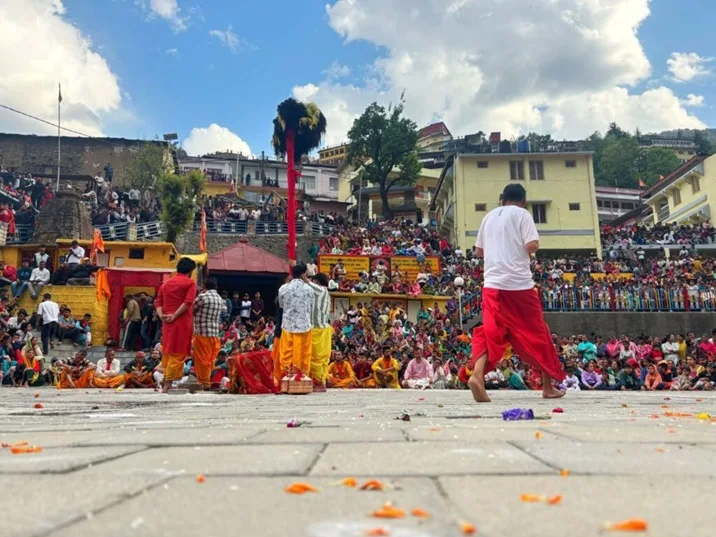
Table of Contents
The Timundiya Mela is a unique annual ritual in Joshimath (Chamoli district, Uttarakhand) linked to the opening of the Badrinath shrine. Held at the Narasingh Temple about one week before the Badrinath Dham’s winter doors open, it honors the local guardian spirit “Timundiya Veer.” The event’s roots lie in a regional myth of a demon subdued by Goddess Durga; since then Timundiya is worshiped as a veer devta (warrior deity) protecting the area.
The festival involves a temple ceremony where the deity is believed to possess a chosen person (pashwa), huge offerings of rice, jaggery and a live goat are made, and traditional Pahadi folk music and dances accompany the rites. The mela is organized by the Narsingh Mandir priests and temple committees to invoke blessings for a safe Badrinath pilgrimage. In recent years the ritual has remained consistent, though attendance was curtailed during the COVID-19 pandemic. No major disputes over the practice are reported in sources. For comparison, the Ramman festival of Saloor-Dungra (Chamoli) – also in Garhwal – is a nearby springtime folk-theatre festival honoring a local deity (Bhumiyal Devta) with masked dances and Ramayana recitals.
Joshimath and the Narsingh Temple
Joshimath (locally Jyotirmath) is a historic Himalayan town at ~6,150 ft serving as the winter seat of several shrines, including Lord Badrinath. Its principal temple is dedicated to Lord Narasimha (Narsingh), an avatar of Vishnu. According to tradition the Narasingh Temple was founded by Adi Shankaracharya (8th century). The temple houses a Shaligram stone idol of Narsingh and, during winter, an idol of Lord Badrinath is brought here for six months while the main Badrinath temple is closed. The spacious temple courtyard (see image below) becomes the site of the Timundiya mela. In local belief the left hand of the Narsingh idol will one day break (ending a dynasty), but until then the temple is the guardian seat of Badri.
Mythological Origins
According to local lore and paurāṇic tales, the Timundiya festival stems from a legend involving a fearsome demon. The story (recounted in Jagran and Navbharat Times) says that long ago a three-headed rakshasa terrorized nearby villages (in Hiyuṇa, Chamoli district), demanding human sacrifices. The guardian goddess Durga of Joshimath intervened. She promised to give the demon a divine body (freeing it from its demonic womb) on condition that each year she would offer it a goat sacrifice; in return, the demon would protect her land as her veer devta. From that time on, the demon became worshiped as “Timundiya Veer” (a valiant deity) rather than slain.
The annual offering to Timundiya thus began, and the demon’s aggression is said to subside into fierce strength under Durga’s control. Local historians say even today when the deity possesses his human host, only Goddess Durga (Navadurga) can safely subdue him.
In summary, the myth portrays Timundiya as the guardian (kshetrapal devta) of Joshimath and the pilgrims to Badri. As one report notes, “Timundiya is Maa Navadurga’s heroic guardian. Locals worship Timundiya as the region’s protector deity”. This back-story explains why the festival exists: to appease this spirit so that the annual Badrinath pilgrimage can proceed safely.
Timing and Organization
The Timundiya Mela is timed precisely with the Char Dham calendar. By longstanding custom, it is held on a Saturday (occasionally Tuesday) about one week before the Badrinath temple’s doors open for the new season (normally around late April/early May). In practice, that means the mela typically falls in April. For example, reports note it took place on April 18, 2026. The main organizer is the Narsingh Mandir’s Dev Puja committee (temple priests) in coordination with the Badrinath-Kedarnath temple committee. Former Dharmadhikari (senior priest) Bhuvan Chandra Uniyal explains that the sole purpose is “the successful conduct of the Badrinath Yatra”. A local committee head (Anil Namburi) confirmed that all preparations are overseen by these temple groups.
No state authority or secular organizer is mentioned in sources; the festival is a purely religious custom. Funding comes from temple trusts and donations. The equipment – large quantities of rice, jaggery, and a sacrificial goat – is supplied by the temple committee (often funded by local sponsors or devotees). One news report noted “last year the previous pashwa (ritual host) died, so only a symbolic ceremony was held; for this year they have made full arrangements and will search for a new pashwa”. This indicates the local priests manage all logistics.
Festival Rituals and Ceremonies
The mela’s events take place entirely within the Narasingh Temple compound in Joshimath. Traditionally on the chosen morning, temple drums (especially the damau and dhol) announce the start of the ceremony. A priest or designated avtari purush (literally “incarnation man”) becomes the pashwa, the earthly “mount” or vessel for Timundiya Veer. According to Jagran, in 2020 the role of pashwa was held by a man from the local Bajwari family, representing the Durga symbol Avanga (trident) and praying for relief from the coronavirus. Generally, the pashwa is a young man from a traditional family who undergoes ritual purification.
Once the deity is invoked, the central act is the bhog (ritual offering) to Timundiya. The Navbharat report describes how the deity (possessing the pashwa) joyfully accepted huge offerings: “almost a quintal (100+ kg) of rice, jaggery, and five pots of water, and an entire raw goat”. These are placed before the idol or the possessed host. Only after all offerings are accepted is the worship deemed complete. The goat is ritually sacrificed, usually behind the temple, its meat cooked or given in prasad. The rice and jaggery are later distributed among priests and devotees as prasad.
Alongside the offering, villagers perform traditional music and dance. Women in colorful Pahadi dress may do folk dances like Jhumelo and Chaachari as part of the celebration. Devotees chant prayers to Durga and to Timundiya. (During COVID restrictions, only a reduced group was allowed; but normally “thousands” of villagers and pilgrims crowd the courtyard to witness the rites.) There is no large public procession – the focus is the temple courtyard. After completion of the puja, aarti lamps may be lit, and the priest(s) pray for the upcoming yatra. The entire ritual typically ends by afternoon, and the Badrinath pilgrimage is considered to begin from that day onward.
Key Features of the Ritual:
- Possession: The deity “Timundiya Veer” is believed to descend into the chosen host (pashwa), who speaks or acts with extraordinary strength during the ceremony.
- Offerings: Very large quantities – ~100 kg of rice and jaggery, 5 ghad (pitchers) of water, and one live goat – are prepared as bhog (prasad).
- Music & Dance: Traditional drums (Damau) and folk dances by women accompany the rite.
- Ritual Order: The ceremony follows a fixed order: invocation of Durga and Timundiya, offering of bhog, acceptance by the deity, and concluding aarti/prayers. Worship is said to be incomplete if offerings are not accepted.
Symbolism and Local Beliefs
The Timundiya festival carries deep symbolic meaning for the local communities. Timundiya (often called Timundiya Veer Devta) is seen as a battlefield hero of the goddess Durga – her veer (warrior). By appeasing him each year, villagers believe he safeguards their lives and their sacred Char Dham (four-shrine) pilgrimage. A report explicitly says: “तिमुंडिया मां नव दुर्गा माँ का वीर है…स्थानीय लोग तिमुंडिया की क्षेत्रपाल देवता के रूप में पूजा करते हैं” – “Timundiya is Goddess Navadurga’s hero, specially offered food on this occasion. Local people worship Timundiya as the guardian deity of the region”. In practice, this means that no Badrinath pilgrimage (Char Dham Yatra) is begun until the Timundiya puja is done. The myth promises “निर्विघ्न यात्रा” – an unhindered journey to Badrinath – if the festival is held respectfully.
Some villagers may feel fear mixed with reverence toward the possessed host, as the deity’s temperament is said to be “extremely ferocious”. Only when Durga’s power coexists (often symbolized by her accompanying the deity during transfer of spirit) is he safely controlled. Thus the joint presence of Durga’s nishan (trident) in the ritual highlights the balance of wild strength and divine protection.
Impact on Community and Tourism
Though largely a local rite, the Timundiya Mela also draws pilgrims heading to Badrinath. Thousands often witness the ceremony, which in turn increases activity in Joshimath that weekend. Devotees from nearby villages participate, and local vendors may sell priestly offerings (like kapala bowls, garlands, prasad packets). The influx provides a modest boost to hotels and shops in Joshimath just before the main pilgrimage season begins. Folk media and some travel blogs have recently highlighted Timundiya as a “mystical festival” to attract interest.
On the other hand, the festival’s role is mainly religious, not commercial. Unlike larger cultural fairs (e.g. Nanda Devi fair), Timundiya is not marketed as a tourist event. It remains confined to religious circles. One news piece noted that in 2020 the mela was “very subdued” due to COVID– many fewer people than usual. This shows how normally it would be a lively public event. However, there is no controversy over attendance or financing in the sources. In fact, local priests lament that overall tourism in Joshimath has fallen (due to recent land-subsidence issues), making village life harder. Nonetheless, the community continues the Timundiya tradition faithfully each year, highlighting its cultural importance.
Modern Changes and Issues
The Timundiya festival has changed little in form over time, but recent events have affected its practice. The COVID-19 pandemic (2020–22) led to strict limits on gatherings nationwide. In 2020, organizers held a shant (restricted) ceremony with only a few participants, whereas a normal year would see crowds. The 2021 Chamoli flood (Rishiganga disaster) caused major damage to Joshimath’s roads and temples, but the festival continued once travel reopened. In late 2020s, Joshimath has faced a serious land-sink problem. Authorities are relocating portions of the town to prevent disasters. As of 2026, the Narsingh Temple and Joshimath are under environmental scrutiny. However, no source reports that the festival itself has been cancelled or moved; it apparently remains on schedule (e.g., reports for 2026 indicate it took place and a new pashwa is being selected). If anything, the festival’s continuity serves as a marker of resilience for local culture despite such challenges.
Controversies: We found no specific disputes about the Timundiya Mela in our sources. Its animal sacrifice (a goat offering) and possession ritual have not been legally contested. By contrast, Uttarakhand’s courts have recently debated similar practices elsewhere: e.g. in August 2025 the High Court allowed goat sacrifices at the Nanda Devi fair under controlled conditions. That case emphasized respecting age-old tradition while minimizing public impact. In short, while animal offerings are a sensitive issue in Himalayan shrines, Timundiya’s ritual remains accepted in the community, and no petition or ban related to it is recorded.
Comparative Festivals in Uttarakhand
Several Himalayan villages hold springtime fairs for local deities. The table below compares Timundiya Mela with a prominent nearby festival.
| Festival | Location (District) | When (Approx.) | Deity / Focus | Key Ritual Elements |
|---|---|---|---|---|
| Timundiya Mela | Joshimath, Chamoli | Mid-April (1 week before Badrinath opens) | Timundiya Veer (local guardian spirit of Goddess Durga) | Ritual possession of a host (pashwa); massive offerings of rice, jaggery, water, and goat; folk dances; blessings for Badrinath Yatra. |
| Ramman Festival | Saloor-Dungra villages, Chamoli | Late April (after Baisakhi) | Bhumiyal Devta (village patron god) | A ritual theatre involving recitations of the Ramayana and local legends, elaborate masked dance-drama, music and community performances. Each caste/age-group has defined roles. Click here to know more about Ramman Festival. |
Sources: The Ramman festival (Saloor-Dungra) is a UNESCO-listed Garhwali ritual theatre held annually in spring, involving masked dances and Ramayana narration for the village deity. Like Timundiya, it blends myth, dance and devotion but differs in form (community theatre vs. possession rite).
Conclusion
– By Mohit Bangari
(20 April 2026)
Related Post

Explore the beauty and cultures of the Himalayas, from Jammu and Kashmir to Arunachal Pradesh, Tibet and Nepal. My blog shares stories, pictures, and fun articles about this amazing region. Come along on a journey where each mountain has a tale and every valley hides a treasure. Join me as I discover the magic of the mountains together.
Welcome to my Himalayan Adventure!