
Chainsoo: The Traditional Garhwali Dish That Gave Strength to Himalayan Villages
– By Mohit Bangari
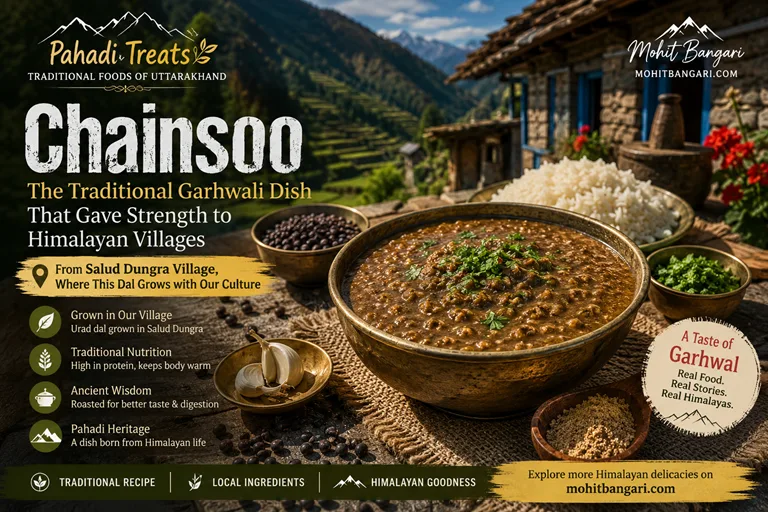
Table of Contents
When we talk about the traditional food of Uttarakhand, names like Kafuli, Phanu, Jhangore Ki Kheer, Dubuk and Arsa often come to mind. However, there is one dish that perfectly represents the wisdom of Himalayan villages – Chainsoo (चैंसू).
This thick and smoky curry made from roasted urad dal has been a part of Garhwali kitchens for generations. It is not just a food item. It is a reflection of mountain life, local farming practices, and the nutritional knowledge of our ancestors.
As part of the Pahadi Treats initiative, which aims to document and promote traditional Himalayan cuisine, Chainsoo deserves special attention. It is one of those dishes that tells us how people in the mountains used local ingredients to create food that was both tasty and highly nutritious.
A Dish Closely Connected to Village Life
I belong to Salud Dungra village in Chamoli district of Uttarakhand. Even today, urad dal is cultivated in our village fields. For generations, local farmers have grown different traditional crops such as mandua, gahat, rajma, bhatt and urad. These crops were not chosen by chance. They were well suited to the climate and terrain of the Himalayas.
Chainsoo developed from this agricultural tradition. Villagers found a unique way to use locally grown urad dal. Instead of simply boiling it, they roasted the whole dal, ground it into powder, and then cooked it into a thick curry.
The result was a dish that could provide warmth, strength and long-lasting energy.
What Exactly is Chainsoo?
Chainsoo is prepared from roasted black gram, commonly known as urad dal.
The traditional method begins by roasting whole urad until it develops a deep brown colour and a rich aroma. The roasted dal is then ground into a coarse powder. This powder is cooked slowly with water, garlic and local spices to create a thick curry.
The roasting process gives Chainsoo its distinct smoky flavour. This flavour is what makes the dish different from ordinary dal preparations.
Traditionally, Chainsoo is served with rice, chapati, mandua roti or local grains.
Why Did Pahadi People Start Eating Chainsoo?
To understand Chainsoo, we need to understand the lifestyle of Himalayan villages in earlier times.
Life in the mountains was physically demanding. People spent long hours working in terraced fields. Women carried grass and firewood from forests. Men travelled between villages on foot. Daily life involved continuous physical effort.
Food was expected to do more than satisfy hunger. It had to provide strength and stamina.
Chainsoo became popular because it fulfilled these requirements perfectly.
It Provided Long-Lasting Energy
Urad dal is rich in protein and carbohydrates. A meal of Chainsoo and rice could keep a person full for several hours.
For farmers working in fields throughout the day, this was extremely important.
Unlike modern processed foods that provide quick energy followed by fatigue, traditional foods like Chainsoo released energy gradually.
It Helped the Body Stay Warm
One of the most common reasons elders give for eating Chainsoo is its warming nature.
In Garhwali households, Chainsoo is often considered a food with “garam taseer”. Mountain winters can be harsh, especially in higher villages. The body needs additional warmth during cold months.
Urad dal naturally generates heat during digestion. This made Chainsoo an ideal food during winter and the rainy season.
Even today, many families prefer Chainsoo on cold evenings.
It Was Easier to Digest
Urad dal can sometimes feel heavy on the stomach. However, the traditional preparation method changes this.
The dal is first roasted, then ground and finally slow-cooked.
This process improves both flavour and digestibility. It shows the practical food wisdom that Himalayan communities developed over centuries.
It Was an Important Source of Protein
Historically, many mountain families depended heavily on pulses for nutrition.
Foods like gahat, bhatt, rajma and urad formed an important part of the local diet.
Chainsoo provided a reliable source of plant-based protein. This helped people maintain strength despite their physically demanding lifestyle.
It Made Good Use of Local Crops
Traditional Himalayan villages were largely self-sufficient.
Families grew most of their food locally. Chainsoo used ingredients that were already available in village fields.
There was no need for expensive spices or ingredients from outside regions.
This made Chainsoo practical, affordable and sustainable.
The Nutritional Benefits of Chainsoo
Modern nutrition science supports many of the traditional beliefs associated with Chainsoo.
Urad dal contains:
Protein
Dietary fibre
Iron
Calcium
Potassium
Magnesium
These nutrients help support muscle development, digestion and overall health.
The high protein content is particularly useful for people engaged in physical work. Fibre helps improve digestion and promotes long-lasting satiety.
This is one reason why Chainsoo continues to remain relevant even today.
A Dish That Represents Himalayan Wisdom
One of the most interesting things about Chainsoo is that it was not created by professional chefs.
It evolved naturally within village communities.
Our ancestors understood their environment. They knew which crops grew best. They understood how food affected the body. They developed cooking methods that enhanced both nutrition and flavour.
Chainsoo is the result of this accumulated knowledge.
In many ways, it represents the practical intelligence of Himalayan society.
Chainsoo and Other Traditional Garhwali Foods
Chainsoo is part of a much larger food tradition.
If you are interested in exploring more traditional dishes from the region, you can also read my detailed article on local foods of Garhwal, where I have discussed dishes like Phanu, Jhangore Ki Kheer, Arsa and several other traditional recipes:
https://mohitbangari.com/local-food-of-garhwal-phaanu-jhangore-ki-kheer-arsa-more/
Each of these dishes reflects a different aspect of Himalayan life and culture.
Similarly, I recently documented Chunya, a lesser-known traditional sweet dish associated with the Joshimath region. Chunya represents another example of how local communities created unique foods using simple ingredients available in the mountains:
https://mohitbangari.com/chunya-joshimath-uttarakhand/
Together, these dishes form an important part of Uttarakhand’s culinary heritage.
Why We Need to Preserve Dishes Like Chainsoo
Today, changing lifestyles and modern food habits are causing many traditional recipes to disappear from everyday kitchens.
Unfortunately, younger generations are becoming less familiar with dishes like Chainsoo, Dubuk, Phanu and Chunya.
If these foods disappear, we will lose more than recipes. We will lose an important part of our cultural identity.
This is one of the main reasons behind the Pahadi Treats initiative. Through this effort, we aim to document, celebrate and preserve the traditional foods of Himalayan villages.
Every traditional dish carries a story. It tells us about farming practices, seasonal cycles, local ingredients and community life.
Chainsoo is one such story.
Final Thoughts
Chainsoo is much more than a simple urad dal curry. It is a food born from the fields of the Himalayas. It reflects the hard work of mountain communities and the wisdom they developed over generations.
For people living in villages like Salud Dungra and many other parts of Garhwal, Chainsoo has long been a source of warmth, strength and nourishment.
As we continue documenting Himalayan cuisine through the Pahadi Treats initiative, Chainsoo stands as a reminder that some of the most valuable foods are often the simplest ones.
The next time you enjoy a bowl of Chainsoo, remember that you are tasting a tradition that has sustained generations of Pahadi families in the Himalayas.
By Mohit Bangari
(23 Jun 2026)
Related Post



Explore the beauty and cultures of the Himalayas, from Jammu and Kashmir to Arunachal Pradesh, Tibet and Nepal. My blog shares stories, pictures, and fun articles about this amazing region. Come along on a journey where each mountain has a tale and every valley hides a treasure. Join me as I discover the magic of the mountains together.
Welcome to my Himalayan Adventure!