
Linguda: The Wild Himalayan Vegetable That Brings the Taste of Monsoon
– By Mohit Bangari
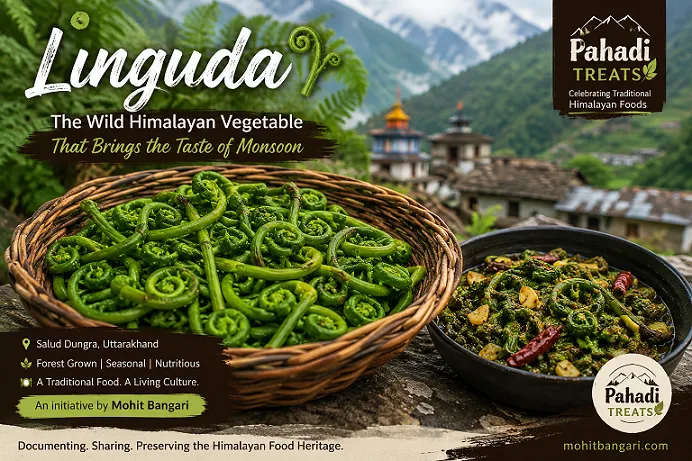
Table of Contents
When people talk about Himalayan food, they often think about dishes like Chainsoo, Kafuli or Mandua ki Roti. However, the forests of the Himalayas have always been another important source of food for mountain communities. Every season brings its own gift, and one such gift is Linguda, a wild vegetable that appears with the arrival of the monsoon.
This article is part of our Pahadi Treats initiative, where we are documenting the traditional foods of Himalayan villages before they slowly disappear from our daily lives. Through this initiative, we want more people to know about the simple yet nutritious foods that have been part of our culture for generations.
For me, this topic is also personal. I belong to Salud Dungra village in Chamoli district, Uttarakhand. Many people know our village because of the famous Ramman Festival, a UNESCO-recognised cultural tradition. If you would like to know more about it, you can read our detailed articles on Ramman Festival and Salud Dungra Village on MohitBangari.com.
But apart from Ramman, our village is also known locally for two traditional forest vegetables – Linguda and Chandra. During the monsoon, many families visit nearby forests to collect these seasonal vegetables. In a future article under Pahadi Treats, I will also share the story of Chandra, another lesser-known Himalayan delicacy.
What is Linguda?
Linguda is a wild edible fern that grows naturally in the forests of the Himalayas. It is not cultivated in farms. Instead, people collect its young shoots directly from the forest during the rainy season.
When the shoots first emerge, they remain tightly curled. This is the stage when they are harvested. As they grow older, the leaves open completely and become too hard to eat.
Because of its seasonal availability, Linguda is something that villagers eagerly wait for every year. The harvesting season usually lasts only a few weeks, making it a special part of the Himalayan monsoon.
Where Does Linguda Grow?
Linguda grows in cool, moist places where there is enough shade and natural water. It is commonly found near forest paths, small streams, natural springs and damp hill slopes.
In Uttarakhand, it grows in many parts of Garhwal and Kumaon. It is also found in Himachal Pradesh, Nepal, Sikkim and several North Eastern states of India, though it is known by different local names.
Unlike many vegetables available in markets throughout the year, Linguda completely depends on nature. Good rainfall and healthy forests play an important role in its growth.
A Tradition Connected With the Forest
For earlier generations in Himalayan villages, collecting forest vegetables was a normal part of life.
During the monsoon, people would leave for the forests in the morning to collect fodder, firewood or medicinal plants. While returning home, they would also bring fresh Linguda. It became an important seasonal vegetable when kitchen gardens had fewer fresh crops.
Even today, many families continue this tradition. The experience is not only about collecting food but also about spending time in the forest and passing traditional knowledge from one generation to another.
How is Linguda Cooked?
One of the reasons people love Linguda is its simple taste and crunchy texture.
In most Garhwali homes, it is first cleaned properly and lightly boiled. After that, it is cooked with mustard oil, garlic, green chillies and basic spices. Some families also prepare it with potatoes, while others prefer making a dry vegetable that can be enjoyed with hot rice or mandua roti.
Every family has its own recipe, but almost everyone agrees that fresh Linguda tastes best during the rainy season.
Is Linguda Healthy?
Yes. Linguda is not only delicious but also nutritious.
It contains dietary fibre, vitamins, minerals and natural antioxidants. Since it is collected fresh from the forest, it becomes a healthy seasonal addition to the traditional Himalayan diet.
Like many wild vegetables, Linguda should always be cooked properly before eating. The tender shoots are the edible part, while mature leaves are generally avoided.
Why Linguda Matters Today
Today, many young people have moved away from villages, and modern food has replaced several traditional dishes. Because of this, many forest vegetables are slowly disappearing from everyday life.
Linguda reminds us that our forests have supported mountain communities for centuries. It also teaches us the importance of protecting forests, because without healthy forests, many traditional foods may disappear forever.
This is one of the main reasons behind the Pahadi Treats initiative. Our aim is not just to share recipes but also to document the stories, traditions and local knowledge connected with Himalayan food.
A Seasonal Gift from the Himalayas
Unlike vegetables that are available throughout the year, Linguda can only be enjoyed for a short period during the monsoon. This limited availability makes it even more special.
Many villagers say that the first appearance of Linguda is a sign that the rainy season has truly arrived. For families living in the mountains, this seasonal connection with nature has always been an important part of life.
Even today, when fresh Linguda appears in local markets, people buy it without waiting, knowing that its season will end quickly.
Final Thoughts
The Himalayas are home to hundreds of traditional foods that are still unknown outside the mountain region. Linguda is one of those hidden treasures.
It is simple, healthy and deeply connected with village life. More importantly, it represents the close relationship between Himalayan communities and their forests.
As someone who grew up in Salud Dungra, I have seen how much people value this seasonal vegetable. Along with Linguda, another forest vegetable called Chandra has also been part of our local food culture for generations. We will explore its story in another article under the Pahadi Treats initiative.
Until then, if you ever visit the Himalayas during the monsoon, do not miss the opportunity to taste freshly cooked Linguda. Sometimes, the most memorable flavours are not found in restaurants but in the simple kitchens of Himalayan villages, where traditions continue to live through food.
By Mohit Bangari
(29 Jun 2026)
Related Post






Explore the beauty and cultures of the Himalayas, from Jammu and Kashmir to Arunachal Pradesh, Tibet and Nepal. My blog shares stories, pictures, and fun articles about this amazing region. Come along on a journey where each mountain has a tale and every valley hides a treasure. Join me as I discover the magic of the mountains together.
Welcome to my Himalayan Adventure!