
Rajula–Malushahi: The Timeless Love Story of Uttarakhand
– By Mohit Bangari
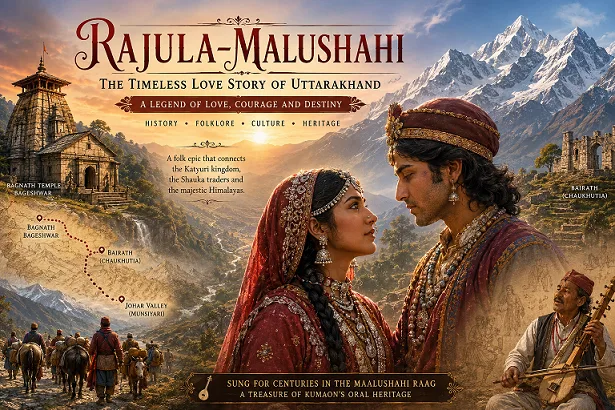
Table of Contents
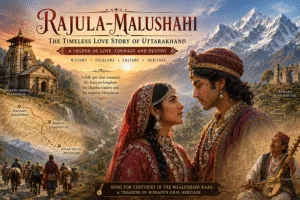
The Himalayas are home to many legends that have passed from one generation to another through songs and oral traditions. Among all the folk tales of Uttarakhand, Rajula–Malushahi holds a special place. It is not just a romantic story. It is a tale of love, courage, sacrifice, faith, politics, and the rich cultural heritage of Kumaon. For centuries, local singers have kept this epic alive through traditional folk music, making it one of the greatest love stories of the Indian Himalayas.
Often compared with Heer-Ranjha, Sohni-Mahiwal, and Laila-Majnu, Rajula–Malushahi is unique because it is deeply connected with the history, geography, and traditions of Uttarakhand. The story reflects the life of the Katyuri rulers, the prosperous Shauka traders of the Himalayas, and the ancient trade routes that once connected India with Tibet.
The Historical Background
Although Rajula–Malushahi is remembered as a folk legend, many historians believe that it is inspired by real people and historical events.
The story belongs to the medieval period when the Katyuri dynasty ruled large parts of present-day Uttarakhand. The Katyuris were among the most powerful rulers of the Central Himalayas between the 7th and 12th centuries. Their kingdom stretched across much of Kumaon and parts of Garhwal.
As the kingdom became weaker, different branches of the Katyuri family started ruling smaller regions. One such kingdom was Bairath, now known as Chaukhutia in Almora district. According to the legend, this was the kingdom of King Malushahi.
During the same period, the Shauka (also known as Rang or Johari) community was famous for trading with Tibet. Their caravans crossed difficult Himalayan passes carrying wool, salt, borax, spices, grains, and other valuable goods. They lived mainly in the Johar Valley near present-day Munsiyari.
The love story of Rajula and Malushahi beautifully connects these two important parts of Uttarakhand’s history—the royal Katyuri kingdom and the prosperous Himalayan trading community.
Who Were Rajula and Malushahi?
Rajula was the daughter of Sunapati Shauka, a wealthy trader from the Johar region. She grew up in a family that was respected across the Himalayas for its successful trade with Tibet. Rajula is remembered as a beautiful, intelligent, and fearless young woman who was ready to challenge society for true love.
Malushahi was the young ruler of Bairath. He belonged to the Katyuri royal family and was known for his courage, wisdom, and devotion to his people. In different versions of the story, he is described either as a prince or as the ruling king of Bairath.
The love between these two young people brought together two very different worlds—one of royal power and the other of Himalayan trade.
The Beginning of the Legend
The story begins long before Rajula and Malushahi were born.
According to the most popular version, King Dola Shah of Bairath and the wealthy trader Sunapati Shauka both visited the sacred Bagnath Temple in Bageshwar. They prayed for children and made a promise before Lord Shiva. If one was blessed with a son and the other with a daughter, the two children would be married when they grew up.
Time passed, and the king was blessed with a son named Malushahi, while Sunapati was blessed with a daughter named Rajula.
However, fate had different plans.
Some versions of the legend say that astrologers warned the royal family that Malushahi’s life was in danger. Because of this prediction, the royal family distanced itself from the promise. Other versions mention changing political conditions after the death of King Dola Shah.
Whatever the reason, the childhood promise was forgotten.
Rajula Learns About Malushahi
Years passed, and Rajula grew into a young woman. She often heard stories about the brave and handsome king of Bairath.
According to folk songs, Rajula saw Malushahi in her dreams even before meeting him. The stories created a deep curiosity in her heart, and slowly that curiosity turned into love.
Meanwhile, her father had different plans.
Sunapati Shauka wanted to strengthen his trading relations by marrying Rajula to King Vikhipal, a powerful ruler from the north. The marriage was expected to bring political and economic benefits to the family.
Rajula strongly opposed the decision.
She believed that promises made before God should never be broken.
Rajula’s Journey to Bairath
One of the most inspiring parts of the legend is Rajula’s journey across the Himalayas.
Travelling during medieval times was extremely difficult. There were no roads, bridges, or vehicles. Dense forests, high mountains, rivers, snow, and wild animals made every journey dangerous.
Yet Rajula decided to travel alone in search of Malushahi.
Her courage is one of the reasons why she is still respected across Kumaon. Unlike many traditional heroines, Rajula takes charge of her own destiny. She refuses to accept a forced marriage and chooses her own path.
After a long and difficult journey, she finally reaches Bairath.
The First Meeting
Different versions describe the meeting differently.
In one version, Rajula successfully meets Malushahi, and both immediately recognise the bond created by their childhood promise.
In another popular version, Malushahi has been placed into a deep magical sleep by his mother. The queen fears that marrying a trader’s daughter may weaken the royal family’s prestige. Therefore, she prevents the meeting.
Rajula waits for him but eventually returns home without seeing him.
Before leaving, she leaves behind a message explaining who she is and why she came.
Malushahi’s Search
When Malushahi finally learns the truth, he is deeply saddened.
He realises that Rajula travelled across dangerous mountains only to fulfil a promise made years ago.
Ignoring royal duties and palace politics, Malushahi decides to find her.
Many folk versions describe him leaving his palace disguised as a wandering ascetic. During his journey, he is said to have met Guru Gorakhnath, one of India’s most respected yogis. The guru blesses him and gives him spiritual strength to continue his search.
This part of the legend adds a spiritual dimension to the story, showing that true love also requires patience, sacrifice, and inner strength.
The Final Conflict
By the time Malushahi reaches Rajula’s homeland, preparations for her marriage with Vikhipal are already underway.
The confrontation between Malushahi and Vikhipal forms the climax of the story.
In some versions, Malushahi defeats his rival after a fierce battle and takes Rajula back to Bairath.
Other versions end on a tragic note. Vikhipal poisons Malushahi, leading to the death of the lovers. Their sacrifice becomes a symbol of eternal love that cannot be defeated even by death.
Because the story has survived through oral traditions for centuries, both endings continue to exist today.
Real Places Connected with the Legend
One of the most fascinating aspects of Rajula–Malushahi is that many locations mentioned in the story still exist.
Bairath (Chaukhutia) is believed to have been Malushahi’s capital.
Bagnath Temple in Bageshwar is associated with the sacred promise made by the fathers of Rajula and Malushahi.
The Johar Valley, near present-day Munsiyari, is traditionally considered Rajula’s homeland. This valley was once an important centre of Indo-Tibetan trade.
Several ancient Himalayan routes used by Shauka traders are also connected with the legend, making the story closely linked with the geography of Kumaon.
Folk Songs and Oral Tradition
Rajula–Malushahi survives mainly because of Uttarakhand’s rich oral tradition.
For generations, folk singers known as Hurkiyas have performed the story during fairs, village gatherings, and cultural festivals.
The epic is sung in the famous Maalushahi Raag, a traditional style of Kumaoni folk music. Earlier, experienced singers could perform the complete story continuously for several nights.
Every singer added small local details, which explains why different versions of the legend exist today.
Cultural Importance
Rajula–Malushahi is much more than a love story.
It preserves the history of the Katyuri rulers, the lifestyle of the Shauka traders, ancient Himalayan trade routes, medieval customs, local beliefs, and the musical traditions of Kumaon.
The legend also presents Rajula as a strong and independent woman who makes her own decisions. This makes her one of the most respected female characters in Uttarakhand’s folk literature.
Even today, schools, cultural organisations, and folk artists perform Rajula–Malushahi to introduce younger generations to the rich heritage of the Himalayas.
History or Folklore?
Historians generally agree that the story contains both historical and fictional elements.
The Katyuri dynasty, Bairath, the Shauka community, Bagnath Temple, and Indo-Tibetan trade are all historically documented.
However, supernatural events, dreams, magical sleep, and some dramatic incidents are part of the folk imagination that developed over centuries.
This combination of history and folklore gives the legend its timeless appeal.
Why Rajula–Malushahi Still Matters
Even after hundreds of years, Rajula–Malushahi continues to inspire people across Uttarakhand. The story reminds us that promises should be honoured, courage can overcome fear, and love often demands sacrifice.
For the people of Kumaon, it is not merely an old folk tale. It is a living part of their identity. Every performance of the epic keeps alive the memories of the Katyuri kingdom, the brave Himalayan traders, and the values that shaped life in the mountains.
As modern life changes rapidly, preserving stories like Rajula–Malushahi becomes even more important. They connect younger generations with their roots and help protect Uttarakhand’s priceless oral heritage.
If you wish to understand the soul of Kumaon, listening to the story of Rajula and Malushahi is one of the best places to begin.
By Mohit Bangari
(11 August 2026)
Related Post




Explore the beauty and cultures of the Himalayas, from Jammu and Kashmir to Arunachal Pradesh, Tibet and Nepal. My blog shares stories, pictures, and fun articles about this amazing region. Come along on a journey where each mountain has a tale and every valley hides a treasure. Join me as I discover the magic of the mountains together.
Welcome to my Himalayan Adventure!