
Khatarua Festival: Is It a Celebration of Kumaon’s Victory Over Garhwal?
– By Mohit Bangari
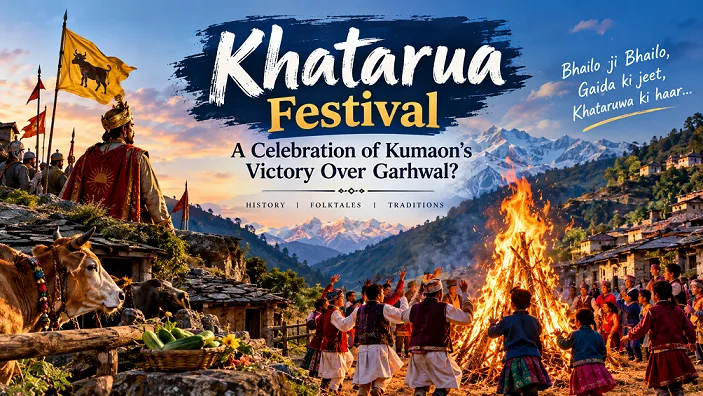
Table of Contents
Khatarua Festival, also written as Khatarwa, Khatduwa or Khathudwa, is one of the old folk festivals of the Kumaon region of Uttarakhand. It is celebrated around Kanya Sankranti, when the monsoon starts ending and the autumn season begins.
At first look, Khatarua appears to be a simple village festival. People collect dry grass and wood, make a small effigy, light a bonfire and sing traditional lines around it. Cattle are also cared for on this day.
However, Khatarua has another important story.
In Kumaon, a strong oral tradition connects this festival with an old Kumaon–Garhwal war. According to this tradition, the festival remembers a victory of the Kumaoni army over the Garhwali army. The famous line “Gaiḍa ki jeet, Khataruwa ki haar” is considered an important clue to this story.
But is Khatarua really a victory festival of Kumaon over Garhwal?
This question has been discussed by historians, writers and local researchers for many years. Some writings connect the festival with a battle between the two hill kingdoms. Others say that the festival is much older and was originally linked with cattle, seasonal change and pastoral life.
To understand Khatarua properly, we need to look at both sides.
When is Khatarua Festival Celebrated?
Khatarua is celebrated on Kanya Sankranti, at the beginning of the Hindu month of Ashwin. In simple terms, it marks the transition from the rainy season towards autumn.
In 2026, Khatarua falls on 17 September. The date changes every year according to the solar calendar.
The timing of the festival is important. After the long monsoon, the weather begins to change. Nights become cooler. In the old villages, people had to prepare their cattle sheds and homes for the coming cold months.
Therefore, the festival has a strong seasonal connection as well.
What is the Meaning of Khatarua?
The word Khatarua is understood differently in different local traditions.
One explanation connects it with Khatar, a term associated with cattle diseases or problems affecting livestock. In this interpretation, the burning of the Khatarua effigy represents the burning away of disease and evil from the cattle and the village.
This is why people say:
“Bhailo ji bhailo,
Bhailo Khataruwa,
Gai ki jeet, Khataruwa ki haar.”
In this meaning, the line can be understood as:
“May the cow win and may Khatarua lose.”
The festival then becomes a prayer for healthy cattle.
On the other hand, another interpretation says that “Gai” or “Gaiḍa” refers to the Kumaoni side in the old war tradition, rather than simply referring to the animal cow.
This second interpretation is particularly important when we study Khatarua as a possible victory festival of Kumaon.
The Older Bhaila or Bhaila Festival Tradition
Before discussing the war story, there is another tradition that needs attention.
It is said that a form of the Bhaila festival was already known in Nepal, Kumaon and Garhwal. The tradition was connected with pastoral communities.
Pastoral people used to celebrate it around the time when their seasonal stay with the cattle was coming to an end. In some descriptions, the festival was connected with the Diwali period.
A person was sometimes dressed or presented in the form of a tiger. A symbolic performance was then carried out in which the tiger figure was driven towards the forest using torches.
Such a tradition makes sense in the old Himalayan pastoral lifestyle. Cattle, forests and wild animals were closely connected with everyday village life.
According to the historical interpretation shared in the local tradition, the form of this old festival later changed. The war memories of the Kumaon and Garhwal kingdoms became attached to the festival.
Over time, the old ritual of burning and driving away an unwanted figure developed into the burning of the Khatarua effigy.
This gives us an important possibility: Khatarua may have older pastoral roots, while its present victory-related meaning may have developed later.
The Kumaon–Garhwal War Story
The most famous story behind Khatarua is linked with the repeated attempts of the Kumaoni ruler Laxmi Chand to defeat the Garhwali forces.
According to the writings and traditions cited by local historians, Laxmi Chand suffered several defeats while fighting towards Garhwal.
The story becomes especially interesting after his seventh defeat.
Historian Shiv Prasad Dabral has been cited in connection with the belief that Laxmi Chand suffered a major defeat at the Panogarh battle.
The defeat was so serious that the king had to be brought back secretly in a kandi, a traditional Himalayan basket used for carrying loads.
The story says that the porters carrying the heavy kandi became tired during the journey. Whenever they stopped to rest, they expressed their anger towards the king through taunts.
One traditional line associated with this incident is:
“Paki raj aapu le chure ki char bhaji noch,
Haman lae dukh dare noch.”
The exact local wording can vary, but the important point is that the folk verse reflects the suffering and anger of ordinary people who had to carry the burden of repeated wars.
This part of the story gives Khatarua a wider social meaning. The wars between hill kingdoms were not only matters between kings and सेनापतियों. Common villagers, soldiers and porters also suffered because of them.
Laxmi Chand’s Preparation for the Eighth Campaign
After repeated defeats, the story says that Laxmi Chand made special preparations for his next campaign.
Badri Datt Pandey is associated with an account in which the king prepared himself in several ways before making another attempt.
According to this tradition, a Tantrik practitioner from Bengal was sent for spiritual practice. The king also received a mantra from his guru and started practising it himself.
At the same time, temples dedicated to Lakshminarayan were constructed at places including Almora and Bageshwar, and prayers were offered for victory.
These details show how warfare and religious belief were closely connected in the medieval Himalayan kingdoms.
The king was not simply preparing soldiers and weapons. Victory was also sought through sadhana, temple worship and divine blessings.
The tradition says that after these preparations, the Kumaoni side finally achieved victory in the eighth campaign.
Gaiḍa and Khatar Singh
The most important part of the Khatarua victory story is the two Senapathis.
According to the popular tradition, the Kumaoni army was led by Gaiḍa or Gainda, while the Garhwali side was led by Khatar Singh.
The Kumaoni victory is remembered through the famous folk chant:
“Bhailo ji bhailo,
Gaiḍa ki jeet,
Khataruwa ki haar.”
Another version is:
“Gaiḍa ki jeet, Khatar ki haar,
Bhajo Khataruwa dhare-dhar.”
Different villages preserve slightly different words and pronunciations.
The central idea, however, remains similar:
Gaiḍa won and Khatar lost.
This is one of the strongest reasons why many people connect Khatarua with a Kumaoni military victory over Garhwal.
The Bonfire and the Victory Memory
Another important part of the tradition is the burning of dry grass and wood.
According to one account associated with Pandit Rudra Datt Pant, after the Garhwal victory, fire was lit on a mountain top using dry grass and wood. The fire or its signal was then carried towards Almora.
The story says that this event later became connected with the practice of lighting fires on the evening of Ashwin Sankranti.
Today, people make a small pile or effigy from dry grass and wood. After sunset, it is set on fire.
Children and elders gather around it. They sing, dance and shout traditional lines.
This makes the bonfire an important part of the festival’s identity.
If the victory tradition is accepted, the fire can be understood as a symbolic memory of the victory.
At the same time, the fire also fits the older seasonal and cattle-related traditions of the festival.
Was Khatar Singh Really the Garhwali Commander?
This is where the history becomes complicated.
Several modern articles and local writings identify Khatar Singh as the Garhwali commander and Gaiḍa as the Kumaoni commander. Some accounts even connect the battle with a fort and give detailed descriptions of how the Kumaoni side defeated the Garhwali forces.
However, not every researcher accepts these details as established history.
Some writers point out that the names Gaiḍa and Khatar Singh are not clearly established in the available medieval historical records. They argue that the names may have developed through oral tradition and were later connected with the festival.
This is an important point.
A folk tradition can preserve the memory of an old event for centuries. But oral tradition can also change with time. Names, places and details can become mixed with later stories.
Therefore, the safest way to write about this subject is to say that the Gaiḍa–Khatar Singh battle is a strong and widely circulated Khatarua tradition, but its exact historical details remain debated.
The 1600’s and the Political Background
The war theory becomes more interesting when we look at the political situation of the time.
The Kumaon kingdom and the Garhwal kingdom were neighbouring Himalayan states. Their political boundaries were not always peaceful. Conflicts and military campaigns took place from time to time.
Some modern accounts connect the Khatarua victory tradition with the period of Laxman Chand/Laxmi Chand of Kumaon and Man Shah of Garhwal, and place the conflict in the early seventeenth century. One commonly repeated date is 1608 CE.
However, the exact identification of the battle behind Khatarua is not universally accepted.
That is why the festival should be studied through both written history and oral history.
The Role of the Cow in Khatarua
There is another fascinating explanation of the famous word “Gai”.
Some traditions understand it simply as cow.
This fits the cattle-centred nature of the festival. People clean their goठ, feed cattle well and pray for their health.
But another interpretation connects “Gai” with the Kumaon royal symbol or with Gaiḍa, the Kumaoni commander.
This makes the line “Gai ki jeet, Khataruwa ki haar” much more political.
Instead of meaning only “the cow has won,” it can be understood in the context of the old Kumaon–Garhwal conflict.
Some local writings have specifically discussed this difference and linked the expression with the Chand dynasty and its symbols.
Khatarua as a Cattle Festival
Even if we focus strongly on the victory story, we should not ignore the cattle traditions.
On Khatarua, families traditionally pay special attention to their cattle.
The Goth is cleaned. Cattle are fed well. In some places, fire from the Khatarua bonfire is taken towards the cattle shed.
The smoke and fire also had a practical side. Burning dry material could help drive away insects from the cattle shed.
Cucumber, or kakdi, is another important part of the festival in many areas. It is shared as a festive food and is sometimes offered near the fire.
The ashes of the burnt Khatarua are also associated with protection from disease and bad influences in some local traditions.
Therefore, Khatarua has clearly retained an important animal and seasonal character, irrespective of the war story.
Why the Kumaon Victory Story Became Important
The Kumaon–Garhwal victory story gives Khatarua a different identity.
The words “Gaiḍa ki jeet, Khataruwa ki haar” are not ordinary festival words. They remember a clear victory and defeat.
The repeated mention of Gaiḍa and Khatar also suggests that a conflict between two sides became part of the oral memory of the festival.
For generations, village children have heard these lines while standing around the bonfire.
That is how history can survive in the mountains.
It does not always survive in a book. Sometimes it survives in a song, a chant, a place name, a ritual or a festival.
At the same time, we should not turn every part of the oral story into a confirmed historical fact. The exact battle, commanders and date need documentary support.
Khatarua Today
Today, Khatarua is not celebrated with the same strength in every Kumaoni village.
Modern lifestyles have changed many old village traditions. Cattle numbers have reduced in some areas. Migration has also affected village life.
Still, the festival survives in many places.
Children continue to gather dry grass and wood. Families prepare cattle sheds. Bonfires are lit. Cucumbers are shared. And the old Bhailo calls still echo in some villages.
The festival therefore remains an important part of Kumaoni folk culture.
It also shows how one festival can carry several layers of memory.
So, Is Khatarua a Celebration of Kumaon’s Victory Over Garhwal?
The answer depends on which layer of the tradition we are discussing.
The victory tradition is certainly an important and widely circulated explanation of Khatarua. The famous lines about Gaiḍa’s victory and Khatar’s defeat strongly support the popular belief that the festival became connected with a Kumaon–Garhwal military victory. Several writers have presented it as a victory festival of Kumaon.
But there is another side.
The festival also has strong links with cattle protection, seasonal change, bonfires and the older pastoral Bhaila tradition. Some researchers therefore believe that these elements are older, while the war story was attached to the festival later.
So, rather than seeing Khatarua through only one story, it is better to understand it as a festival with multiple historical layers.
Its present identity carries the memory of cattle, changing seasons, village life and, according to a strong Kumaoni oral tradition, the victory of Kumaon over Garhwal.
Final Words
Khatarua is much more than a bonfire festival.
It carries the memory of an old Himalayan society where cattle were central to village life, where seasonal changes decided the rhythm of living and where stories of kings and battles travelled from one generation to another through folk songs.
The words “Gaiḍa ki jeet, Khataruwa ki haar” remain at the heart of the victory tradition.
Whether every detail of the Gaiḍa–Khatar Singh story can be proved through written history is still a matter of debate. But the tradition itself is very much part of Kumaon’s folk memory.
That is what makes Khatarua interesting.
It stands at the meeting point of history, लोककथा, पशुपालन, seasonal change and Kumaoni identity.
And perhaps this is the best way to understand the festival — not simply as a festival of fire, and not simply as a war victory, but as a living tradition in which different memories have come together over generations.
Related Articles
If you are interested in Uttarakhand’s folk festivals and traditions, you can also read my detailed article on Harela Mela – A Festival of Green, Growth & Kumaoni Culture. Harela also shows how deeply the traditional festivals of Kumaon are connected with nature, agriculture and village life.
You can also explore my Himalayan Festivals Calendar, where I have covered many festivals from Uttarakhand and other Himalayan regions month by month.
By Mohit Bangari
(17 September 2026)
Related Post



Explore the beauty and cultures of the Himalayas, from Jammu and Kashmir to Arunachal Pradesh, Tibet and Nepal. My blog shares stories, pictures, and fun articles about this amazing region. Come along on a journey where each mountain has a tale and every valley hides a treasure. Join me as I discover the magic of the mountains together.
Welcome to my Himalayan Adventure!