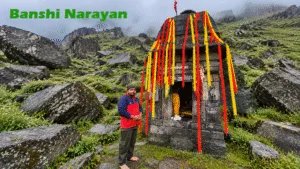
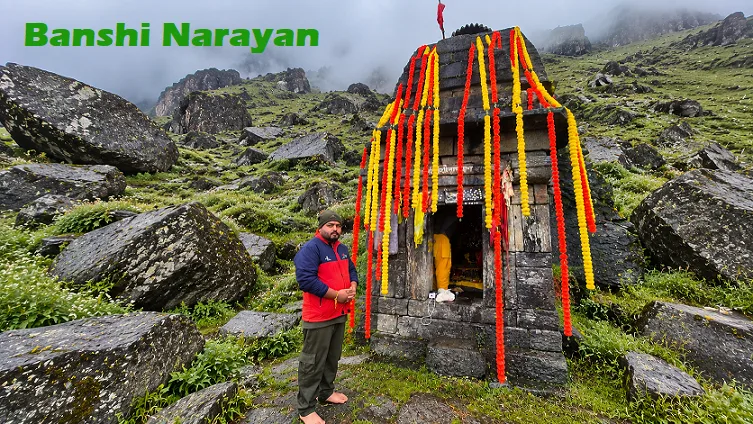
Banshi Narayan Temple is one of the most interesting ancient temples in the Garhwal Himalayas. Located in the beautiful Urgam Valley of Chamoli district, this temple is dedicated to Lord Vishnu. It is known for its peaceful surroundings, old stone architecture and strong connection with Raksha Bandhan.
For many years, the temple has been known as a place that opens only once a year. However, the local people of Kalgoth village have now decided to start a new tradition. They want to keep the temple open for six months, just like Badrinath and Kedarnath, so that devotees can visit and worship Lord Narayan for a longer period.
The journey to Banshi Narayan also takes you into the wider cultural landscape of Joshimath and Urgam Valley. This region is known for its ancient temples, local deities and traditional festivals. If you want to explore more about the folk culture of Joshimath, you can also read about the Timundiya (Trimundiya) Festival of Joshimath, the Ramman Festival and Chunya, a lesser-known religious place near Joshimath.
I recently visited Banshi Narayan Temple through the Kalgoth route. We started our journey on the evening of the 27th and returned on the 28th. During the visit, I also got the opportunity to see the पूजा at the temple. This made the journey more special because Banshi Narayan is not only a trekking destination. It is also an important part of the local faith and culture of Urgam Valley.
Where is Banshi Narayan Temple Located?
Banshi Narayan Temple is located in the Urgam Valley of Chamoli district, Uttarakhand. The temple stands at an altitude of around 3,600 metres above sea level, surrounded by forests, green meadows and the high Himalayan landscape.
The temple is situated in a remote area, away from the busy towns and main pilgrimage routes. This is one of the reasons why the place still has a peaceful atmosphere.
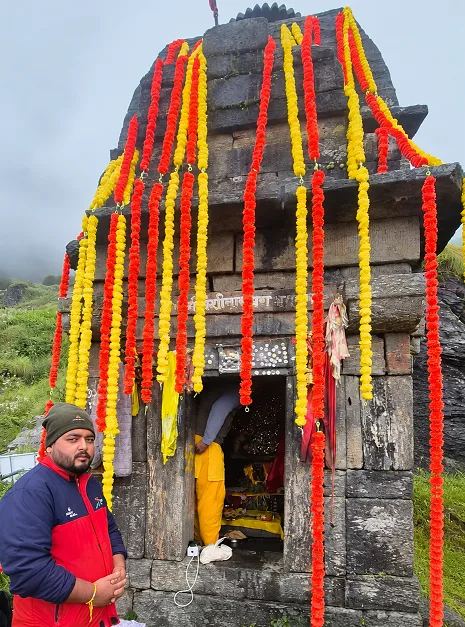
According to travel sources, the temple is associated with the ancient Katyuri style of architecture. It is a small stone temple with a quadrangular idol of Lord Narayan. However, the exact date of its construction is not firmly established. Some sources describe it as an 8th-century temple, but this should be treated as a traditional or commonly reported date rather than a fully verified historical fact.
The temple is also surrounded by beautiful Himalayan scenery. On a clear day, visitors can enjoy views of the surrounding mountains, forests and alpine meadows. The natural beauty of the area makes the journey as interesting as the temple itself.
There Are Two Routes to Banshi Narayan Temple
One of the important things I noticed during my visit is that Banshi Narayan Temple can be reached through two main routes. Both routes are connected with the villages of Urgam Valley.
1. Urgam Village Route
The first route starts from Urgam Village. From here, visitors have to trek for around 13 km to reach Banshi Narayan Temple.
This is the route that is commonly mentioned in travel guides. The trek passes through beautiful forests, mountain meadows and traditional village areas. It is a good option for those who want to enjoy the natural beauty of Urgam Valley while walking towards the temple.
The route is also connected with several other religious places in the valley. Some travel sources mention places such as Urva Rishi Temple, Mulkhark, Bhagwati Devi Temple, Chetarpal Temple and Nokchuna Dhar along the wider trekking route.
2. Kalgoth Village Route
The second route is through Kalgoth Village. This is the route that I personally used during my visit.
Kalgoth is connected to Urgam by road. The distance from Urgam to Kalgoth is around 15 to 20 km by road, depending on the route and starting point. After reaching Kalgoth, visitors have to trek for around 6 to 7 km to reach Banshi Narayan Temple.
This route is shorter on foot compared to the Urgam route. However, it is still a mountain trek, and the trail can be tiring because of the altitude and uphill sections.
The Kalgoth route is also important from a religious point of view. The पूजा at Banshi Narayan Temple is traditionally performed by the people of Kalgoth village. This is one of the most important local traditions connected with the temple.
My Journey to Banshi Narayan Temple
I recently visited Banshi Narayan Temple through the Kalgoth route. We started our journey on the evening of the 27th and returned on the 28th.
The journey was not only about reaching the temple. It was also about experiencing the local traditions and the peaceful atmosphere of the Himalayas.
After reaching Kalgoth, we continued our journey towards the temple on foot. The route passes through the beautiful mountain landscape of Urgam Valley. The forests, green meadows and fresh mountain air make the trek enjoyable.

One of the most special parts of the visit was that पूजा was performed at the temple in the evening as well as the next day. This gave us an opportunity to see the local worship tradition closely.
The temple was not just a place where we stopped for darshan. It felt like a living part of the local culture. The people of Kalgoth have a strong connection with Banshi Narayan, and this connection can be seen in the way they manage the पूजा and other traditions.
The Mythological Story of Banshi Narayan Temple
Banshi Narayan Temple is connected with a popular story from Hindu mythology. The story is related to Lord Vishnu, Mata Lakshmi, Narad Muni and King Bali.
According to the local belief, Lord Vishnu once went to Patala Lok, where King Bali was the ruler. In some versions of the story, King Bali had taken Lord Vishnu with him and made him stay there.
Mata Lakshmi wanted Lord Vishnu to return. She then asked Narad Muni for a solution. Narad Muni suggested that she should go to Patala Lok on the day of Raksha Bandhan and tie a Rakhi to King Bali.
Mata Lakshmi followed his advice. She went to Patala Lok and tied a Rakhi to King Bali. After this, she asked him to release Lord Vishnu. King Bali agreed, and Lord Vishnu returned with Mata Lakshmi.
According to the local belief, this event is connected with the tradition of Raksha Bandhan at Banshi Narayan Temple.
It is also believed that Narad Muni used to worship Lord Narayan at Banshi Narayan Temple throughout the year. However, on the day of Raksha Bandhan, he could not perform the पूजा because he had gone to Patala Lok with Mata Lakshmi.
At that time, the people of Kalgoth village performed the पूजा at the temple. Since then, the tradition has continued.
This is one of the most important stories connected with Banshi Narayan Temple. It explains why the temple has such a strong connection with Raksha Bandhan and why the people of Kalgoth have a special role in its worship.
These are local religious beliefs and oral traditions. They are an important part of the cultural identity of the temple, but they should not be treated as independently verified historical facts.
Why Banshi Narayan Temple Opens on Raksha Bandhan
For many years, Banshi Narayan Temple has been known for opening only once a year on Shravan Purnima, the day of Raksha Bandhan.
According to local tradition, the temple remains closed for most of the year. On Raksha Bandhan, devotees visit the temple to worship Lord Narayan and seek his blessings.
The festival is especially important for women. Many women visit the temple and offer Rakhi to Lord Narayan before tying Rakhi to their brothers.
The temple also has a tradition of offering butter. According to local accounts, the people of Kalgoth bring butter from their homes for the पूजा. This butter is used to prepare prasad, which is then offered to Lord Narayan and distributed among the devotees.
This tradition makes Raksha Bandhan at Banshi Narayan different from the usual celebrations. Here, the festival is not only about brothers and sisters. It is also about the relationship between the local people and their deity.
The New Tradition of Keeping the Temple Open for Six Months
One of the most important developments connected with Banshi Narayan Temple is the decision of the people of Kalgoth village to keep the temple open for six months.
According to the local people, the temple will now be opened for a longer period, similar to the traditions followed at Badrinath and Kedarnath.
The idea is to allow devotees to visit the temple and perform पूजा for a longer period instead of waiting for only one day in the year.
This is an important step for the temple because it can make the pilgrimage easier for more people. It can also help the local villages by bringing more visitors to the area.
However, the exact opening dates, पूजा schedule and other arrangements may depend on the local temple committee and the people of Kalgoth. Visitors should confirm the current arrangements before planning their journey.
What Makes Banshi Narayan Temple Special?
Banshi Narayan Temple is special for several reasons.
First, it is an ancient temple dedicated to Lord Vishnu. Second, it is located in a beautiful and remote part of the Garhwal Himalayas. Third, it has a strong connection with Raksha Bandhan.
But the most important thing is its connection with the local people.
The पूजा at Banshi Narayan is traditionally performed by the people of Kalgoth village. This makes the temple different from many other famous pilgrimage places in Uttarakhand.
The temple is not only a religious place. It is also a part of the local culture, traditions and history of Urgam Valley.
How to Reach Banshi Narayan Temple
To reach Banshi Narayan Temple, visitors first need to reach Joshimath. From Joshimath, they can travel towards Urgam Valley.
The temple can then be reached through either the Urgam route or the Kalgoth route.
For the Urgam route, visitors need to travel to Urgam Village and then trek for around 13 km.
For the Kalgoth route, visitors can travel by road from Urgam to Kalgoth and then trek for around 6 to 7 km to reach the temple.
The Kalgoth route is a good option for those who want a shorter trek. However, the route is still located in a high-altitude area, so visitors should be prepared for mountain conditions.
Best Time to Visit Banshi Narayan Temple
The best time to visit Banshi Narayan Temple depends on the purpose of your journey.
If you want to experience the main religious tradition, Raksha Bandhan is the most important time to visit.
If you want to enjoy the trek and the natural beauty of the area, spring, summer and early autumn are generally better seasons. During these months, the weather is more suitable for trekking and the surrounding landscape is beautiful.
However, visitors should be careful during the monsoon season because the mountain roads and trekking trails can become slippery. Landslides and heavy rain can also affect travel in the region.
Travel Tips for Banshi Narayan Temple
Before planning your journey to Banshi Narayan Temple, keep the following points in mind:
- Choose your route according to your fitness and travel plan.
- If you are taking the Urgam route, be prepared for a longer trek.
- If you are taking the Kalgoth route, confirm the road conditions before travelling.
- Carry enough drinking water and food for the trek.
- Wear proper trekking shoes.
- Carry warm clothes because the temple is located at a high altitude.
- Avoid travelling during heavy monsoon rain.
- Confirm the पूजा schedule and temple opening dates before your visit.
- Respect the local traditions and the people who manage the temple.
- Avoid littering and keep the trekking route clean.
Final Thoughts
Banshi Narayan Temple is one of the most beautiful and culturally important temples of Urgam Valley. Its ancient history, local traditions and connection with Raksha Bandhan make it a special place for devotees and travellers.
My visit through the Kalgoth route was a memorable experience. The journey was not only about trekking to a remote temple. It was also about seeing how the local people keep their traditions alive.
The decision to keep the temple open for six months can make Banshi Narayan more accessible to devotees. It can also help more people discover the beauty and culture of Urgam Valley.
For anyone interested in Uttarakhand temples, Himalayan pilgrimage, local folk traditions and lesser-known travel destinations, Banshi Narayan Temple is definitely a place worth exploring.
Frequently Asked Questions About Banshi Narayan Temple
Where is Banshi Narayan Temple located?
Banshi Narayan Temple is located in the Urgam Valley of Chamoli district, Uttarakhand. The temple stands in the Garhwal Himalayas, surrounded by forests and mountain meadows.
How can I reach Banshi Narayan Temple?
There are two main routes to Banshi Narayan Temple. One route starts from Urgam Village and involves a trek of around 13 km. The other route goes through Kalgoth Village. Kalgoth is around 15 to 20 km by road from Urgam, followed by a trek of approximately 6 to 7 km to the temple.
Which route is shorter to Banshi Narayan Temple?
The Kalgoth route is shorter on foot. It involves around 6 to 7 km of trekking from Kalgoth Village. However, the road journey from Urgam to Kalgoth adds around 15 to 20 km.
Who performs the पूजा at Banshi Narayan Temple?
The पूजा at Banshi Narayan Temple is traditionally performed by the people of Kalgoth Village. They have a special connection with the temple and its worship traditions.
Why is Banshi Narayan Temple famous?
Banshi Narayan Temple is famous for its ancient Lord Vishnu shrine, beautiful Himalayan location and strong connection with Raksha Bandhan. It is also known for its traditional once-a-year opening.
Why does Banshi Narayan Temple open on Raksha Bandhan?
According to local belief, Narad Muni used to worship Lord Narayan at the temple throughout the year. When he went to Patala Lok with Mata Lakshmi to bring Lord Vishnu back, the people of Kalgoth performed the पूजा in his absence. This tradition is believed to have continued since then.
What is the story of Banshi Narayan Temple?
The local legend connects the temple with Lord Vishnu, Mata Lakshmi, Narad Muni and King Bali. According to the story, Mata Lakshmi tied a Rakhi to King Bali on Raksha Bandhan and asked him to release Lord Vishnu from Patala Lok. King Bali agreed, and Lord Vishnu returned with Mata Lakshmi.
Is Banshi Narayan Temple open throughout the year?
Traditionally, the temple remained closed for most of the year and opened on Raksha Bandhan. However, the people of Kalgoth Village have now decided to keep the temple open for six months, similar to Badrinath and Kedarnath. Visitors should confirm the current opening dates and पूजा schedule before planning their journey.
What is the altitude of Banshi Narayan Temple?
Banshi Narayan Temple is located at an altitude of around 3,600 metres above sea level. The high-altitude location makes the trek more challenging than an ordinary village walk.
What is the best time to visit Banshi Narayan Temple?
Raksha Bandhan is the most important time to visit if you want to experience the main religious tradition. For trekking and enjoying the surrounding landscape, spring, summer and early autumn are generally more suitable.
Is Banshi Narayan Temple suitable for beginners?
The Kalgoth route is shorter, but it is still a high-altitude trek. Beginners should prepare properly, walk at a comfortable pace and avoid travelling without checking the weather and trail conditions.
What should I carry for the Banshi Narayan Temple trek?
Carry warm clothes, trekking shoes, drinking water, food, a first-aid kit and essential medicines. A rain jacket is also useful because mountain weather can change quickly.
Is there accommodation near Banshi Narayan Temple?
Accommodation options are limited near the temple. Visitors generally stay in nearby villages such as Urgam or Kalgoth and plan the trek accordingly. It is better to confirm accommodation before travelling.
Can I visit Banshi Narayan Temple through Kalgoth Village?
Yes. The Kalgoth route is one of the main ways to reach Banshi Narayan Temple. From Kalgoth, the trek is around 6 to 7 km.
Why is Banshi Narayan Temple important for Uttarakhand’s culture?
Banshi Narayan Temple is important because it connects local faith, ancient temple traditions and the natural landscape of the Garhwal Himalayas. The पूजा tradition of Kalgoth Village is an important part of its cultural identity.
By Mohit Bangari
(06 September 2026)