
Devidhura Bagwal Mela: History, Folk Tradition and the Famous Stone-Fighting Festival of Uttarakhand
– By Mohit Bangari
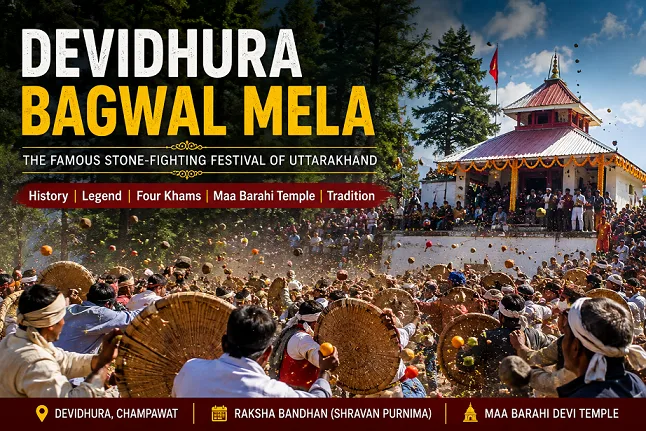
Table of Contents
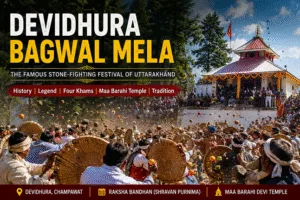
Devidhura Bagwal Mela is one of the most unique traditional fairs of Uttarakhand. It is held every year at Devidhura in Champawat district during Raksha Bandhan, on the full moon day of Shravan. The fair is famous across Uttarakhand because of its traditional Bagwal, in which people belonging to four traditional Khams come together for a symbolic battle.
The most unusual part of this festival is the traditional use of stones. In the old form of Bagwal, participants threw stones at one another while protecting themselves with wooden shields called Farra. The sight was both dramatic and dangerous. Over the years, however, the tradition has changed. Fruits and flowers are now used as a safer form of the ritual, although stones may still appear in some circumstances.
The Maa Barahi Devi Temple is at the heart of this tradition. Uttarakhand Tourism describes the temple as being at an altitude of around 1,850 metres and around 60 km from Lohaghat. It also identifies the four groups associated with Bagwal as Gahadwal, Chamyal, Walik and Lamgadiya.
For readers who prefer Hindi, every article on this website also has a language option. You can switch from English to Hindi with a single click. This is especially useful for articles about local culture because many Kumaoni and Garhwali terms are easier to understand in their original language.
Where is Devidhura Bagwal Mela held?
Devidhura is located in Champawat district of Uttarakhand. It is an important cultural and religious place in the Kumaon region.
The place lies in a mountainous area surrounded by forests and large rock formations. Older records describe Devidhura as a high ridge with a remarkable landscape of huge granite rocks and forests. The 2011 District Census Handbook records Devidhura at about 2,021 metres above sea level and describes it as the location of the famous Varahi Devi temple.
The modern road network has made Devidhura much easier to reach than in the past. Earlier, the region was connected with Almora and other places through traditional foot routes. Today, roads connect it with Champawat, Lohaghat and the wider Kumaon region.
Devidhura is also important because of its location close to the meeting area of the Almora, Pithoragarh and Nainital regions. This geographical position helped the place develop as an important cultural meeting point.
Maa Barahi Devi Temple
The Maa Barahi Devi Temple, also called Varahi Devi Temple, is the main religious centre of Devidhura.
The Champawat district administration describes Devidhura as famous for the Varahi Temple and its cultural heritage associated with Bagwal.
The goddess is worshipped here as Barahi or Varahi. In Hindu tradition, Varahi is associated with the Varaha form of Lord Vishnu and is also counted among the powerful forms of the Devi tradition.
The temple has a special place in the religious life of the local communities. Devotees visit it throughout the year, but the biggest gathering takes place around the Bagwal Mela during Raksha Bandhan.
There are also interesting natural rock formations around the temple. Local beliefs connect some of these rocks and caves with Maa Barahi. Such beliefs form an important part of the oral heritage of Devidhura.
The Champawat district website also notes the traditional and mythological importance of the Barahi temple and other ancient religious sites of the district.
What is Bagwal?
The word Bagwal is generally associated with the traditional stone-fighting ritual of Devidhura.
However, calling it simply a “stone fight” does not fully explain its meaning.
For the local people, Bagwal is connected with Maa Barahi, community identity, old traditions, bravery and religious belief. It is performed according to a set ritual rather than being an ordinary fight.
The participants traditionally belong to four Khams. The four groups are commonly identified as:
Chamyal Kham
Gahadwal Kham
Lamgadiya Kham
Walik or Balig Kham
Different historical and modern sources use slightly different spellings for some of these names. The local pronunciation and identity, however, remain important.
The four Khams are also associated with several Thoks. Modern accounts mention seven Thoks connected with the tradition, including Chamyal, Gahadwal, Lamgadiya, Walig, Gorna, Katna and Phularakot.
The legend behind Devidhura Bagwal
The most popular story connected with Bagwal is the story of Narbali.
This is a local lok-katha, and it should be understood as a traditional belief rather than as established historical fact.
According to the story, human sacrifice was once associated with the worship of Maa Barahi. The responsibility for the sacrifice was connected with the four Khams.
One year, the turn came to an old woman who had only one grandson. She was deeply distressed because the boy was her only family member.
The old woman prayed to Maa Barahi and requested that her grandson be spared.
According to the legend, the goddess accepted her devotion. Instead of the sacrifice of the boy, she gave another condition. An amount of blood equal to that of a human body had to be offered to the goddess.
The four Khams then accepted this condition.
According to the popular belief, the tradition of Bagwal began from this point. Instead of sacrificing one person, people would injure one another and offer their blood to Maa Barahi.
This story explains why blood and injury became connected with the old form of Bagwal.
The Government of India’s Utsav portal also records this traditional story and describes the four Khams as the groups connected with the ritual.
It is important to remember that this is a religious folk tradition. There is no need to present the Narbali story as proven historical evidence.
The four Khams and the two sides of Bagwal
Although four Khams participate in the festival, the traditional contest is organised into two sides.
The two sides are traditionally associated with Mahar and Fartyal.
On Bagwal day, the participants gather with their respective groups. They enter the religious space, take part in the rituals and then move towards the traditional Bagwal ground.
The participants are known locally as Dhanku in connection with their dedication to the goddess.
Drums, dhol-damna, nagada, hurki and other traditional instruments add to the atmosphere. Along with the music, local songs and heroic Bhadeli verses create a powerful cultural setting.
Thus, Bagwal is not only about throwing stones. It is also a combination of religious worship, folk music, dance, community participation and traditional martial culture.
How Bagwal is played
The main Bagwal takes place after the religious rituals are completed.
The four Khams reach the traditional field. Participants take their positions according to their groups.
In the older form of Bagwal, stones were thrown from one side towards the other. Participants protected themselves using Farra, a traditional shield. Some shields were made from wood, while local materials such as Ringal were also associated with traditional shield-making.
Another interesting local word is Chhantuli, which refers to the traditional shield used for protection.
The field becomes filled with the sound of drums and local songs. People raise slogans in praise of Maa Barahi and other local deities.
Traditionally, the contest continued until the ritual was considered complete. The priest’s signal marked the end of Bagwal.
After the Bagwal, the opposing groups traditionally meet and embrace each other. This is an important part of the festival because the event represents a ritual contest, not permanent hostility between communities.
Why stones were used in Bagwal
The use of stones is connected with the old belief that the blood offered during the Bagwal represented the substitute for human sacrifice.
That is why the traditional ritual became known for its dangerous stone-pelting.
However, the practice created serious concerns because people could suffer major injuries.
Over time, the administration and courts became involved in making the festival safer. Uttarakhand Tourism records that the Uttarakhand High Court intervened in 2013 and directed that stones should be replaced with flowers and fruits.
As a result, the modern Bagwal has increasingly become a symbolic fruit-and-flower Bagwal.
Apples, pears and flowers are now commonly used. The basic idea of the traditional ritual remains, but the level of physical danger has been reduced.
Bagwal in the present day
The modern Devidhura Bagwal is very different from the violent version described in older accounts.
In recent celebrations, large quantities of fruits and flowers have been used instead of stones. For example, a recent report recorded the use of several quintals of fruits and flowers during the festival. Even then, injuries were reported, showing that the event still needs careful management.
This change is important because it shows how a traditional festival can continue while adapting to modern safety requirements.
The aim is not to remove the cultural identity of Bagwal. Instead, the focus is on keeping the ritual, community participation and religious significance alive without unnecessary danger.
Devidhura and its ancient archaeological importance
Devidhura is important not only because of Bagwal.
The surrounding region also has considerable archaeological interest.
Your historical material mentions the work of W. J. Henwood, who studied the large rock formations of the area in 1856. Later researchers also examined the megalithic remains and burial-related features found in the wider Kumaon region.
The huge rocks around Devidhura are particularly interesting. Older traditions and archaeological studies have connected some of these formations with megalithic burial practices.
Megalithic traditions involve the use of large stones in connection with burial, memorial or ritual structures. Similar traditions are known from different parts of India and from other parts of the world.
The historical material associated with Devidhura describes different types of stone burial arrangements. These include natural rock cavities, stone-covered burial spaces and later memorial marks made on rocks.
However, the exact dating and interpretation of individual remains should be treated carefully. Archaeological claims about Devidhura need to be separated from local folklore.
This makes Devidhura particularly interesting for anyone studying the history, archaeology and folk culture of Uttarakhand.
The landscape of Devidhura
One of the most beautiful things about Devidhura is its natural setting.
Older descriptions speak of a plateau-like area surrounded by large rocks and forests. The combination of huge granite formations and Himalayan trees gives the place a distinctive appearance.
For visitors, the landscape adds another dimension to the Bagwal experience.
The temple, forest, rocks, traditional music and thousands of visitors together create a very different atmosphere from an ordinary village fair.
This is one reason why Devidhura should not be seen only as a place where Bagwal takes place. It is also a religious and cultural landscape.
Devidhura Mela and local culture
The Bagwal Mela provides a rare opportunity to see several aspects of Kumaoni culture together.
Visitors can experience:
Local religious rituals
Maa Barahi worship
Traditional music
Dhol and Nagada
Folk songs
Traditional shields
Local dress
Community gatherings
Folk beliefs and oral history
Traditional food and local market culture
In the past, fairs such as Devidhura also acted as important trading centres.
Historical descriptions mention traders and sellers arriving from different parts of Kumaon and neighbouring Himalayan areas. Items such as woollen products, Pashmina, Thulma, copper vessels and other local goods were associated with Himalayan fairs.
Therefore, the Mela was not only a religious event. It was also a place where people met, exchanged goods and maintained social relationships.
Devidhura Bagwal and other Indian festivals
India has many festivals that may look unusual to outsiders but have deep local meanings.
For example, the Hornbill Festival of Nagaland celebrates the cultural traditions and tribal heritage of the state. You can read more about it in my article:
Hornbill Festival – The Grand Celebration of Tribal Unity in Nagaland
Similarly, the Ramman Festival of Uttarakhand is another excellent example of how religion, folk performance, community traditions and local identity come together in a Himalayan festival.
These festivals are different from Bagwal, but all of them show the cultural diversity of India.
Another important Uttarakhand fair is the Gauchar Mela, which has a different history and character but is also an important meeting point of trade, culture and local communities.
When is Devidhura Bagwal Mela held?
The main Bagwal takes place on Raksha Bandhan, which falls on the full moon day of the Hindu month of Shravan.
The wider festival activities, however, are not limited to only a few hours on Raksha Bandhan.
Religious preparations and rituals begin before the main day. The different Khams and Thoks participate in the traditional ceremonies connected with Maa Barahi.
The main attraction remains the Bagwal on the full moon day.
Because the date of Raksha Bandhan changes every year according to the Hindu calendar, visitors should check the official programme before planning their trip.
Best time to visit Devidhura
If your main purpose is to experience the Bagwal Mela, Shravan Purnima or Raksha Bandhan is the most important time.
However, this is also the busiest period.
Thousands of people gather at Devidhura during the festival. Roads can become crowded, parking can be difficult and accommodation may fill quickly.
Therefore, travellers should plan in advance.
Those who want a quieter experience can visit Devidhura outside the main Mela period and explore the temple and surrounding landscape without the huge festival crowd.
How to reach Devidhura
Devidhura is connected by road with important towns of Kumaon.
The nearest major road connections include Champawat, Lohaghat and Almora.
According to the Government of India’s Utsav portal, the nearest major airport listed for the fair is Jolly Grant Airport, while Kathgodam is the nearest convenient railway station mentioned on the portal.
However, travellers should check current road conditions before starting the journey because Himalayan routes can change due to monsoon rain, landslides and other weather conditions.
During the Bagwal Mela, traffic management can also change according to the administration’s arrangements.
Things to remember while visiting the Bagwal Mela
Devidhura is a religious and cultural gathering, so visitors should respect local traditions.
Do not enter restricted areas during the Bagwal.
Follow instructions given by the police, administration and Mela organisers.
If you are photographing the ritual, maintain a safe distance.
Do not treat Bagwal as an ordinary entertainment event. For local people, it has a deep religious and cultural meaning.
The traditional stone-pelting also carries a risk of injury. Therefore, visitors should never try to participate without proper permission or ignore safety arrangements.
Devidhura Bagwal is more than a stone fight
For someone seeing Bagwal for the first time, the stones, shields, drums and huge crowd may appear to be the main attraction.
But the real story goes much deeper.
It connects Maa Barahi worship, local folklore, ancient community traditions, Khams and Thoks, folk music, archaeology and the social history of Kumaon.
The old form of Bagwal was dangerous, but the modern festival shows how a community can preserve its traditional identity while changing the form of a ritual according to present-day safety needs.
The replacement of stones with fruits and flowers is an important example of this change.
At the same time, the stories associated with Narbali, the old Khams, the traditional Farra, the Ringal shields, the Bhadeli songs and the ancient rocks of Devidhura keep the memory of the old tradition alive.
That is what makes the Devidhura Bagwal Mela special.
It is not simply a fair.
It is a living part of the cultural heritage of Uttarakhand.
Frequently Asked Questions about Devidhura Bagwal Mela
Where is Devidhura Bagwal Mela held?
Devidhura Bagwal Mela is held at Maa Barahi Devi Temple in Devidhura, Champawat district, Uttarakhand.
When is Devidhura Bagwal Mela celebrated?
The main Bagwal takes place every year on Raksha Bandhan, on the full moon day of Shravan.
What is Devidhura Bagwal famous for?
Devidhura is famous for its traditional Bagwal, in which members of four Khams participate in a symbolic ritual contest. Traditionally stones were used, while modern celebrations mainly use fruits and flowers.
Which four Khams participate in Bagwal?
The four traditional Khams are Chamyal, Gahadwal, Lamgadiya and Walik/Balig.
What is Farra in Devidhura Bagwal?
Farra is the traditional shield used by participants to protect themselves during Bagwal.
Why do people play Bagwal?
According to local folklore, Bagwal developed as a substitute for the old practice of Narbali associated with Maa Barahi. This is a traditional religious story and should not be treated as proven historical fact.
Is stone pelting still done at Devidhura?
The traditional stone-pelting has largely been replaced by fruits and flowers as part of efforts to make the festival safer. However, reports from recent celebrations show that some stones may still be used during the ritual.
Which district is Devidhura in?
Devidhura is in Champawat district of Uttarakhand.
Why is Devidhura archaeologically important?
The area has large rock formations and megalithic remains that have attracted historical and archaeological interest. Older researchers, including W. J. Henwood, studied the rock formations and remains of the region.
Final Words
The Devidhura Bagwal Mela gives us a glimpse into a very old layer of Himalayan culture. Its stories have travelled through generations mainly through lok-katha, oral traditions and community practices.
Today, the festival continues with a changing form. Fruits and flowers have reduced the dependence on stones, but the identity of Bagwal remains alive.
For anyone interested in Uttarakhand culture, Kumaoni traditions, Himalayan fairs, folk stories and ancient religious practices, Devidhura is a place worth understanding.
The best way to look at Bagwal is not simply as a strange festival where people throw things at one another. It should be seen in the wider context of Maa Barahi, local society, ancient traditions and the cultural history of Kumaon.
That wider story is what makes Devidhura Bagwal one of the most fascinating traditional fairs of Uttarakhand.
By Mohit Bangari
(24 August 2026)
Related Post


Explore the beauty and cultures of the Himalayas, from Jammu and Kashmir to Arunachal Pradesh, Tibet and Nepal. My blog shares stories, pictures, and fun articles about this amazing region. Come along on a journey where each mountain has a tale and every valley hides a treasure. Join me as I discover the magic of the mountains together.
Welcome to my Himalayan Adventure!