
Chunya: The Forgotten Makar Sankranti Delicacy of Joshimath Region, Uttarakhand
– By Mohit Bangari
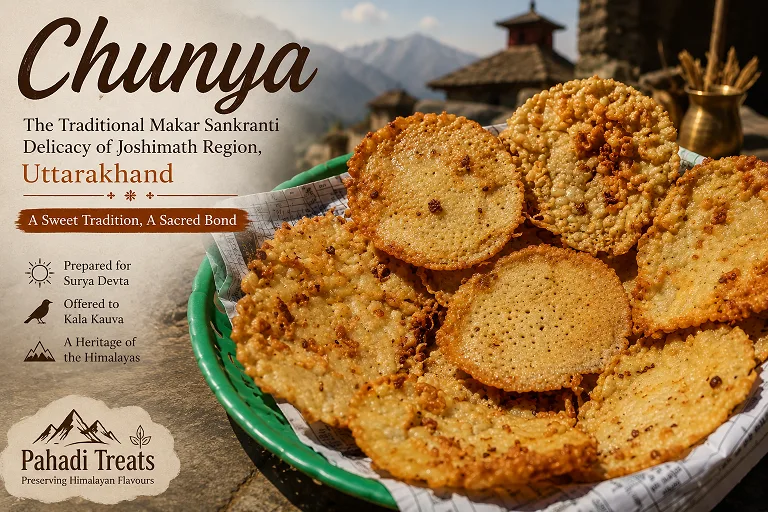
Every region of Uttarakhand celebrates Makar Sankranti in its own way. In Kumaon, the festival is widely known as Uttarayani, while many parts of Garhwal celebrate it with traditional foods and local customs. However, in the villages around Joshimath, this festival has another unique identity. Here, many people know it simply as Chunya.
For outsiders, Chunya may sound like the name of a dish. In reality, it is both a traditional festive delicacy and the local name of the Makar Sankranti celebration itself. This unique tradition has been preserved for generations in the villages of the Joshimath region.
As someone belonging to Saloor Dungra village, I grew up hearing elders talk about Chunya and watching children eagerly wait for the festival. It was never just about food. It was a celebration of family, community, nature, and local beliefs that have shaped life in the Himalayas for centuries.
Through this article under the Pahadi Treats initiative, I want to document this lesser-known Himalayan food tradition before it slowly disappears from public memory.
What is Chunya?
Chunya is a traditional sweet and crispy delicacy prepared during Makar Sankranti in the Joshimath region of Uttarakhand. It is made from a special batter known locally as Chunya Peetha.
The batter is prepared using:
- Rice
- Black lentils (Urad Dal)
- Wheat flour
- Jaggery syrup
Unlike many other festive sweets, Chunya is not baked or cooked in a deep vessel. Instead, it is fried on a special flat iron griddle known as a Tay (तय).
The result is a thin, crispy, slightly sweet preparation with a unique taste and texture. For many families, the aroma of freshly prepared Chunya marks the arrival of the Sankranti festival.
Why is the Festival Called Chunya?
One of the most interesting aspects of this tradition is that the festival itself takes its name from the dish.
In many villages of the Joshimath region, people say:
“Chunya aa gayi” (Chunya has arrived)
instead of simply saying Makar Sankranti or Uttarayani.
This reflects the deep connection between local food traditions and cultural identity. The dish became so important to the celebration that its name eventually became synonymous with the festival itself.
The Traditional Recipe of Chunya
The preparation of Chunya requires patience and experience.
Traditionally, rice, urad dal, and wheat flour are soaked in water for several hours. Once softened, they are ground into a smooth batter. This mixture forms the base known as Chunya Peetha.
The most important ingredient is jaggery. Fresh jaggery syrup is mixed into the batter before cooking.
The balance of ingredients is extremely important.
If the batter contains too much jaggery, it sticks to the Tay. If the consistency becomes too thick, the Chunya does not spread properly and turns into a thick fritter rather than a thin crispy disc.
Experienced women in the village understand these proportions instinctively. Many families still follow recipes passed down through generations without using any written measurements.
If you want to read more about Local Food of Garhwal, you can read it here.
The Importance of Tay
No discussion about Chunya is complete without mentioning the traditional Tay.
A Tay is a special flat-bottomed iron griddle used specifically for preparing Chunya. Unlike modern frying pans, it has a completely flat cooking surface that allows the batter to spread evenly.
The Tay is more than just a cooking utensil. It represents a part of Himalayan culinary heritage.
Today, very few blacksmiths make traditional Tay, and many younger families no longer own one. As a result, the knowledge associated with Chunya preparation is slowly declining.
Documenting both Chunya and Tay is therefore important for preserving the food culture of the region.
Offering Chunya to the Sun God
Makar Sankranti marks the transition of the Sun into Capricorn and the beginning of Uttarayan.
Like many Himalayan traditions, Chunya is closely connected with the worship of Surya Devta (the Sun God).
Before family members eat the freshly prepared Chunya, it is traditionally offered to the Sun. This act expresses gratitude for warmth, crops, prosperity, and the natural cycles that sustain life in the mountains.
For farming communities that have depended on nature for generations, such rituals hold deep meaning.
The Beloved Tradition of Calling the Crows
One of the most memorable parts of Chunya festival is the tradition of feeding crows.
Early in the morning, children carry Chunya and Khichdi outside their homes and call out to crows using traditional phrases.
A commonly heard chant is:
“Punya le kauva bhaat, sono hath… le kauva chunya…”
The voices of children echo through the village as they wait for the first crow to arrive.
For many people who grew up in the hills, these memories remain among the most cherished moments of childhood.
Why Are Crows Important?
In local folklore, crows hold a special place.
They are often considered messengers of the gods and symbolic links to ancestors. Feeding them on auspicious occasions is believed to bring blessings, prosperity, and good fortune to the household.
This belief is not limited to Joshimath. Similar traditions can be found across many parts of Uttarakhand. However, in the Joshimath region, the offering of Chunya gives this ritual its own distinctive identity.
The tradition also reflects the close relationship between Himalayan communities and nature.
Birds, animals, forests, rivers, and mountains have always played an important role in local beliefs and customs.
Chunya and the Himalayan Way of Life
Traditional Himalayan foods were never created only for taste.
Most dishes carried cultural, seasonal, and spiritual significance.
Chunya is a perfect example.
The ingredients used in its preparation were easily available in village households. Rice, wheat, urad dal, and jaggery formed part of everyday mountain life.
The festival brought families together. Women prepared Chunya, elders shared stories, children called the crows, and communities celebrated the arrival of a new agricultural cycle.
In this way, food became a medium through which traditions, values, and memories were passed from one generation to the next.
Why Chunya Deserves Recognition
Today, many traditional Himalayan foods are disappearing from public memory.
Modern lifestyles, migration from villages, and changing food habits have reduced the popularity of several local dishes. Chunya is among those traditions that remain largely undocumented.
While sweets like Bal Mithai and Singori are well known across Uttarakhand, very few people outside the Joshimath region have heard about Chunya.
Yet it represents an important part of the region’s cultural identity.
Preserving such food traditions is essential because they tell the story of local communities, their environment, and their way of life.
Pahadi Treats: Preserving Forgotten Himalayan Flavours
The goal of the Pahadi Treats initiative is to document and celebrate traditional Himalayan foods that are slowly fading from memory.
Chunya is one such culinary treasure.
It is not just a sweet dish. It is a symbol of Makar Sankranti in the Joshimath region. It connects food with faith, family, folklore, and community life.
As long as Chunya continues to be prepared in village homes and children continue calling out to the crows on winter mornings, an important part of Himalayan heritage will remain alive.
And perhaps that is the true spirit of Chunya — a simple traditional delicacy carrying centuries of culture within every crispy bite.
By Mohit Bangari
(21Jun 2026)
Related Post



Explore the beauty and cultures of the Himalayas, from Jammu and Kashmir to Arunachal Pradesh, Tibet and Nepal. My blog shares stories, pictures, and fun articles about this amazing region. Come along on a journey where each mountain has a tale and every valley hides a treasure. Join me as I discover the magic of the mountains together.
Welcome to my Himalayan Adventure!
1 thought on “Chunya: The Forgotten Makar Sankranti Delicacy of Joshimath Region, Uttarakhand”
You have done very in-depth research. Please keep writing in the future as well. We read all of your articles